


When a third molar develops a deep cavity or infection, the standard clinical reflex is often immediate extraction. However, modern endodontics offers an alternative.
If you are experiencing severe localized pain in the back of your mouth, you may actually be a viable candidate for a wisdom tooth root canal, rather than a surgical removal. For patients seeking specialized Root Canal Treatment in Koramangala and HSR Layout, understanding the precise clinical criteria for saving this tooth is the first step toward making an informed, evidence-based decision about your oral health.
The third molars, commonly known as wisdom teeth, are infamous for causing structural crowding and painful impactions. Because of this reputation, there is a widespread medical misconception that a diseased wisdom tooth has zero restorative value.
This is clinically inaccurate. Our treatment philosophy is driven by objective diagnostics, not blanket assumptions. If your wisdom tooth is fully erupted, properly aligned, and actively contributing to your chewing function, preserving it is often a superior biological outcome compared to losing a natural tooth.
Navigating this decision requires clinical clarity. To help you understand your options, our endodontic specialists have answered the most common patient questions regarding the infection, treatment complexity, and long-term viability of saving your third molar.
Medical Disclaimer
The information provided in this guide regarding endodontic procedures, dental abscesses, and extraction protocols is intended strictly for educational and informational purposes. It does not constitute formal medical advice, a definitive clinical diagnosis, or a personalized treatment plan. The viability of a wisdom tooth root canal depends entirely on individual anatomical factors, including root curvature, extent of decay, and systemic health.
Always consult directly with a licensed endodontist or oral surgeon to undergo comprehensive diagnostic imaging and determine the safest, most effective treatment protocol for your specific condition. Never delay seeking professional emergency dental care based on the contents of this article.
Q1: How Does a Wisdom Tooth Become Infected?
As wisdom teeth are located at the very back of the oral cavity, they present an anatomical challenge. They are difficult to reach with standard toothbrushes and dental floss, creating an ideal environment for plaque, food debris, and harmful bacteria to accumulate unnoticed. Over time, these bacteria produce organic acids that erode the tooth’s protective layers.
When decay is left unchecked, it penetrates the outer enamel and the underlying dentin, eventually breaching the central pulp chamber, which contains the tooth’s blood vessels and nerves.
Once bacteria invade this sterile space, the nerve tissue becomes inflamed and begins to die. Without prompt endodontic intervention, the infection travels down the complex root canals and exits through the apex of the root into the surrounding jawbone. This localized buildup of inflammatory fluid and bacteria leads directly to the formation of a dental abscess, an acute and painful condition that signals a severe, spreading infection requiring immediate emergency clinical care.
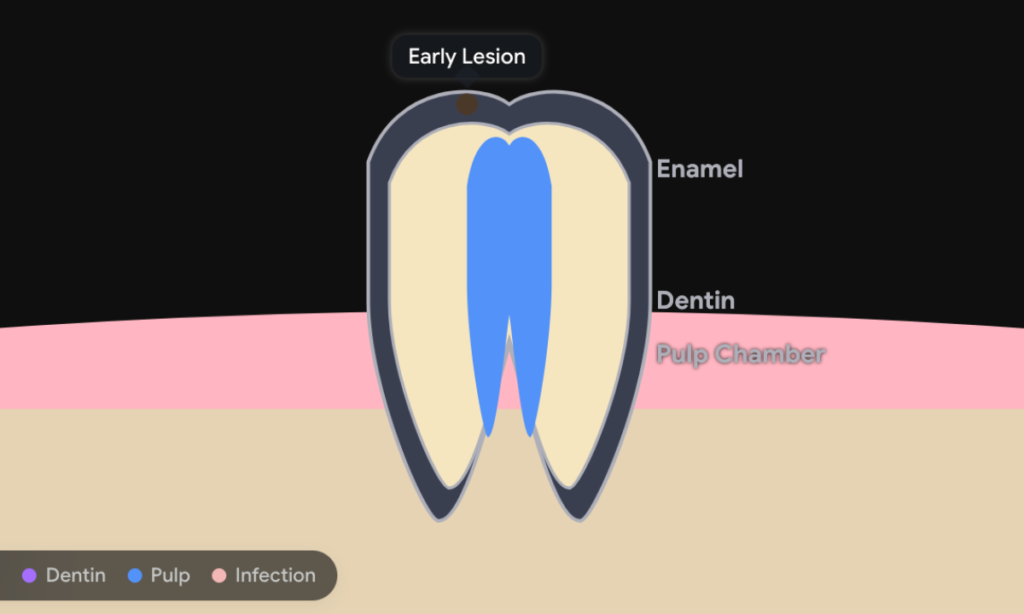
| Anatomical Impact | Symptoms | Intervention |
| Enamel surface | Asymptomatic | Remineralization/Filling |
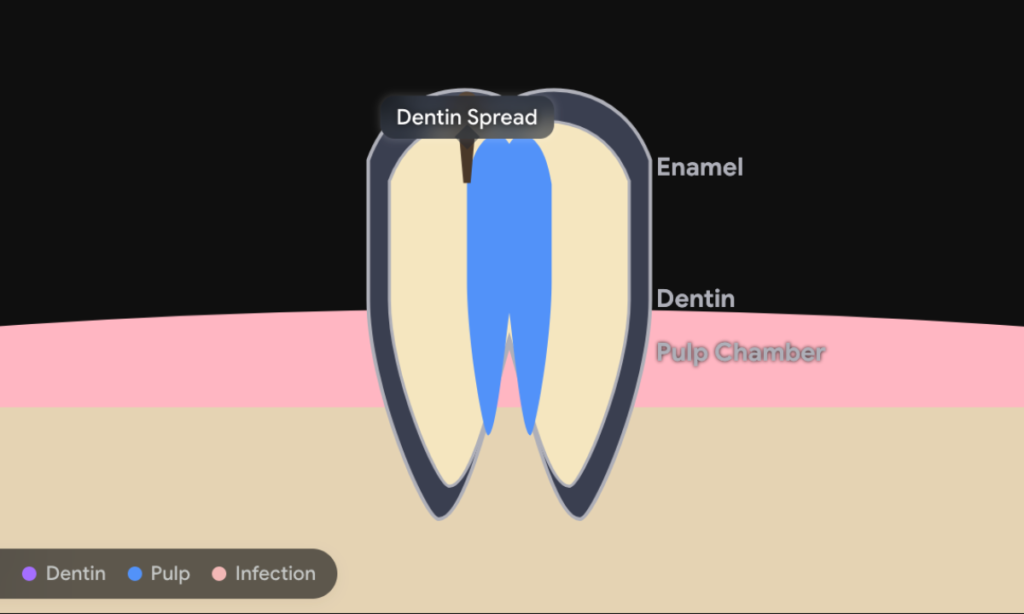
| Anatomical Impact | Symptoms | Intervention |
| Dentin penetration | Thermal sensitivity | Restorative filling |
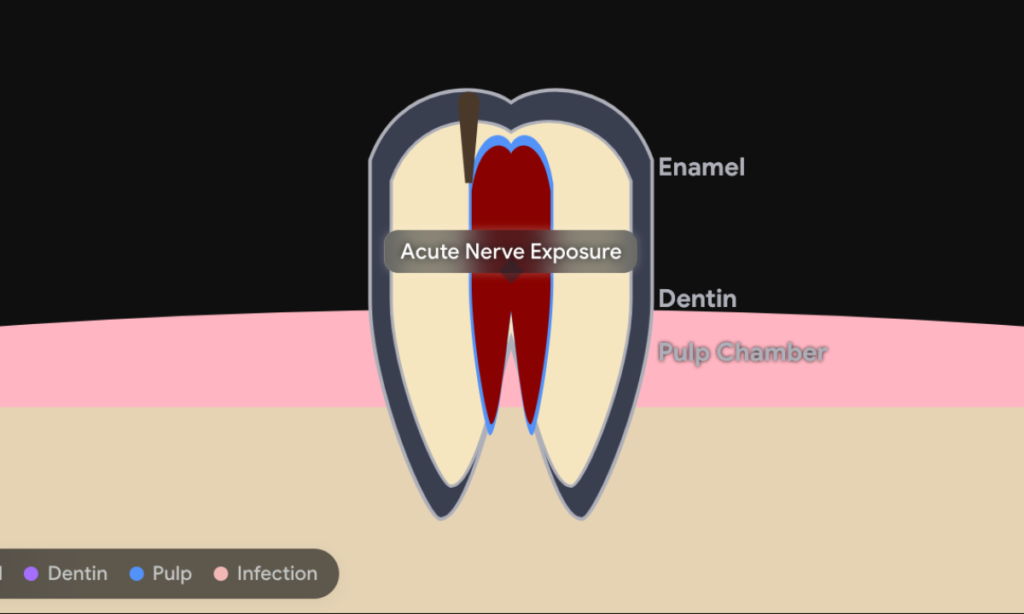
| Anatomical Impact | Symptoms | Intervention |
| Pulp infection | Thermal Acute throbbing pain | Root canal therapy |
Root Canal vs. Extraction: Which is Right for Me?
When an infection is confirmed, your endodontist must make a critical clinical decision: save the tooth or remove it. The debate of Root Canal vs Extraction depends on several factors, including the tooth’s structural integrity, position, and long-term function. While standard wisdom tooth root canal treatment is highly effective at eradicating infection, it is only recommended if the tooth holds lasting structural value. If the tooth is poorly positioned, severely damaged, or serves no functional purpose, extraction is often the safer and more predictable treatment option.
To determine the correct path, your specialist will conduct a comprehensive evaluation using advanced 3D imaging to assess the tooth’s exact angulation, its relationship to neighboring teeth, and its proximity to major facial nerves.
Here is a clinical breakdown of how endodontists differentiate between a tooth worth saving and a tooth requiring surgical removal:
| Clinical Criteria | Indication for a Root Canal (Preservation) | Indication for an Extraction (Removal) |
| Eruption Status | The tooth is fully erupted, completely visible above the gum line, and accessible. | The tooth is impacted (partially or fully trapped beneath the gums or jawbone). |
| Functional Chewing | The tooth directly aligns with an opposing wisdom tooth, actively contributing to a healthy bite. | The tooth has no opposing partner, rendering it functionally useless for chewing. |
| Positional Alignment | The tooth is growing straight upward and does not interfere with neighboring molars. | The tooth is growing at a severe angle (horizontal or mesial impaction), threatening adjacent teeth. |
| Restorability | Sufficient healthy tooth structure remains above the gum line to support a protective dental crown post-treatment. | The decay is so extensive that the tooth structurally collapses or decays below the bone level. |
If your diagnostic imaging reveals an impacted or severely angled third molar, Wisdom Teeth Removal in HSR Layout and Koramangala is the definitive standard of care to prevent future crowding, chronic gum infections, and damage to your surrounding dentition.
However, if your third molar meets the criteria for preservation, a root canal allows you to retain your natural chewing surface.
Q3: Is it Harder to perform a Root Canal on a Wisdom Tooth?
From a clinical perspective, treating a third molar is considerably more demanding than treating a standard front tooth or premolar. Wisdom teeth have complex internal anatomy.
While a standard lower molar typically has three distinct, relatively straight root canals, a wisdom tooth may present with severely curved roots, fused root systems, or hidden microscopic branches that diverge at sharp angles.
Attempting to successfully clean and seal an infected wisdom tooth root canal using outdated 2D X-rays and the naked eye is the primary reason these procedures often fail in standard dental clinics. The endodontist simply cannot thoroughly disinfect what they cannot clearly see.
At DDC Smiles, we eliminate this anatomical guesswork by bringing hospital-grade diagnostic technology. We manage the complexity of third molars by relying on two critical technological pillars:
1. 3D Dental CBCT (PaX-i3D) Scanning: Before the procedure even begins, we capture a high-definition, 360-degree topographical map of your entire jaw. This allows our endodontists to virtually rotate your wisdom tooth on a screen, measure the exact curvature of the roots, and identify any hidden accessory canals, ensuring there are no anatomical surprises during the treatment.
2. Micro-Endodontics (Dental Operating Microscopes): A root canal is essentially a microscopic microsurgery. Our specialists utilize advanced dental operating microscopes that provide up to 25x magnification and intense, focused illumination deep into the tooth. This allows the endodontist to meticulously clean out every microscopic trace of infected tissue from the most difficult-to-reach crevices of the root system.
Combining 3D diagnostic mapping with microscopic precision, a procedure that is considered “too difficult” or “impossible” for a general dentist becomes a highly predictable, safe, and successful preservation treatment in the hands of our endodontic specialists.
Q4: Is Saving the Tooth Worth the Investment?
When discussing advanced dental procedures, financial transparency is just as important as clinical clarity.
It is a common patient assumption that an extraction is automatically the smarter financial choice simply because the initial wisdom tooth root canal cost is higher than a routine surgical removal. However, evaluating this decision purely on upfront pricing ignores the long-term biological economics of your mouth.
To determine if saving the tooth is a sound investment, you must look beyond the immediate procedure and consider the architectural integrity of your bite.
The Hidden Cost of Extraction
If your wisdom tooth is fully erupted and actively engaged in your daily chewing cycle (meaning it bites down directly against an opposing upper or lower wisdom tooth), extracting it completely disrupts your occlusal harmony.
When you remove a functional lower molar, the opposing upper molar loses its chewing partner. Without that physical resistance, the upper tooth will naturally begin to drift downward out of the gum socket over time, a biological process known as supra-eruption.
This shifting exposes the sensitive roots of the upper tooth, creates deep periodontal pockets that trap food, and often leads to eventual decay and a perfectly healthy tooth.
The Biological ROI of Preservation
If your clinical imaging confirms the tooth is functional:
1. Preserving it via endodontic treatment maintains your natural jaw structure, prevents adjacent teeth from drifting, and eliminates the domino effect of future dental complications.
2. The ROI: You retain a natural chewing surface for life, completely bypassing the future costs associated with treating supra-erupted opposing teeth or bite misalignments.
Conversely, investing time and finances into a root canal for a poorly positioned, impacted, or completely non-functional third molar is a poor clinical and financial decision.
Our commitment to ethical dentistry means we will never recommend preserving a wisdom tooth unless our 3D diagnostics prove it provides a definitive, long-term structural benefit to your overall oral health.
Q5: Is a Wisdom Tooth Root Canal Painful, and What is the Recovery Like?
The most pervasive myth in endodontics is that root canal procedures are inherently painful. In reality, the intense, throbbing pain you experience before your appointment is caused entirely by the bacterial infection actively destroying the nerve tissue and increasing pressure within the tooth structure.
The root canal procedure is the definitive clinical intervention designed to eliminate that pain, not cause it.
The Pain-Free Procedure
Modern endodontics has evolved significantly. Because a wisdom tooth root canal is a highly precise microsurgery, profound pain management is the first step of the protocol. We utilize advanced local anesthesia delivery systems to completely numb the third molar and the surrounding deep tissue before any instrumentation begins.
Patients routinely report that the physical sensation during the procedure is no different from having a standard dental filling placed, merely a sensation of pressure and mild vibration.
The Recovery Timeline
Because preserving the tooth via a root canal is a non-surgical procedure (unlike a surgical extraction that requires bone removal and sutures), the biological recovery is remarkably fast.
1. The First 24 to 48 Hours:
Once the anesthesia wears off, it is completely normal to experience mild to moderate tissue tenderness around the injection sites and the ligaments that support the tooth.
This is a natural inflammatory response to the instrumentation and can typically be managed effectively with standard over-the-counter anti-inflammatory medications (such as Ibuprofen).
2. The First Week:
You will be advised to avoid chewing hard or crunchy foods directly on the treated wisdom tooth until a permanent restorative crown is placed. The tooth structure is temporarily fragile after the internal nerve tissue is removed.
3. Long-Term:
Once the tooth is permanently sealed and crowned, it integrates seamlessly back into your natural chewing cycle with zero residual discomfort.
Choosing preservation over extraction at a top-tier Dental Hospital in Koramangala and HSR Layout, you bypass the surgical recovery phase associated with wisdom tooth removal, which often involves days of significant swelling, dietary restrictions, and the risk of complications like dry socket.
Why Choose DDC Smiles for Complex Endodontics?
When dealing with a deep-seated infection in a third molar, the outcome of your procedure relies entirely on the diagnostic capabilities and specialized training of your clinical team.
DDC Smiles does not operate as a standard, localized clinic; we are a comprehensive Dental Hospital in Koramangala and HSR Layout, engineered specifically to manage complex oral surgeries and advanced endodontic cases under one roof.
Patients consistently trust our facility for high-stakes tooth preservation for three definitive reasons:
1. In-House 3D Diagnostics:
When you are in severe pain, you should not be forced to travel to a separate diagnostic lab. We house the advanced PaX-i3D Dental CBCT scanner on-site, allowing our team to capture high-definition, 3D anatomical maps of your jaw instantly.
2. Specialized Expertise: General dentists frequently refer complex third molar cases to specialists. At DDC Smiles, our treatments are led by specialized endodontists and overseen by Dr H.J. Jaikrishna, an MDS with over two decades of clinical leadership and a 98% success rate in complex rehabilitations.
A root canal is a sterile microsurgery. We operate under a rigorous 6-step sterilization protocol utilizing Class B Autoclaves, ensuring an absolutely uncompromising, zero-infection environment for every patient.
Conclusion
A diagnosed cavity in your third molar does not automatically mandate an extraction. While surgical removal is the absolute correct protocol for impacted or non-functional teeth, a fully erupted, properly aligned wisdom tooth holds genuine structural value. By electing for advanced Root Canal Treatment in Koramangala and HSR Layout, you can effectively eradicate the infection, eliminate the pain, and preserve your natural chewing architecture for life.
Do not rely on 2D assumptions when it comes to tooth extraction. If you are experiencing acute pain in the back of your jaw, book a consultation at DDC Smiles.
Let our endodontic specialists map your precise anatomy with 3D imaging, provide absolute clinical clarity, and help you determine whether your tooth is worth saving.
Reference:
1. https://www.csddentistry.com/2025/08/19/wisdom-teeth-root-canals-understanding-the-pain-process-purpose/
2. https://www.md.co.uk/blog/root-canal-wisdom-tooth
