


Maintaining a vibrant smile requires understanding how daily habits shape your developing enamel. While fluoride is celebrated worldwide for its ability to protect enamel from decay, excessive intake during early childhood can lead to fluorosis of the teeth, a condition characterized by faint white lines or cosmetic discoloration.
Identifying this early often starts during routine preventive care, such as booking a regular session for teeth cleaning in Bangalore, where subtle surface changes can be evaluated before they alter your smile’s aesthetics.
It is reassuring to note that this condition is primarily a cosmetic issue rather than a painful dental emergency or a sign of structural decay. In its mild forms, the underlying strength and health of the tooth remain fully intact.
Empowering our patients through education, demystifying enamel variations, and providing the precise diagnostic clarity you need to look past surface stains and step forward with absolute oral confidence is what we keep our faith in.
Medical Disclaimer
The clinical insights, anatomical explanations, and cosmetic strategies presented in this guide are intended strictly for educational and informational purposes. This content does not constitute professional medical or dental advice, a formal diagnosis, or a personalized treatment plan. Enamel discoloration and mineralization profiles are highly unique characteristics influenced by genetics, regional water chemistry, and developmental history.
Always consult a qualified dentist or a board-certified cosmetic specialist to evaluate your specific enamel condition before beginning any microabrasion, chemical bleaching, or restorative dental protocol. Never delay seeking professional oral care based on the material read in this article.
What Exactly is a Fluorosis Tooth?
To understand how this condition alters the appearance of your smile, it is helpful to look at the microscopic architecture of human enamel.
Enamel is the highly mineralized, protective outer layer of your teeth, composed almost entirely of dense calcium and phosphate crystals. Under normal conditions, these crystals pack tightly together during early childhood development, creating a smooth, translucent surface that allows light to pass through naturally.
When an excess of fluoride is introduced to children while their permanent teeth are still forming beneath the gums, it subtly interferes with the natural mineralization process. This disturbance causes an increase in enamel porosity, a biological state known to dental professionals as hypomineralization.
Essentially, a fluorosis tooth features an altered crystal framework where the subsurface enamel retains more moisture and minerals than standard teeth, creating tiny, microscopic gaps within the structure.
This structural variation does not make the tooth soft or more prone to cavities; in fact, mild forms can actually make the teeth highly resistant to decay. Instead, the primary impact is optical. As the porous enamel scatters light differently from dense, fully mineralized enamel, the tooth loses its uniform translucency.
This structural change shifts the appearance of the tooth surface, transforming clear enamel into the distinctive opaque white spots or chalky streaks that characterize the condition.
Root Factors and Exploring the Causes of Dental Fluorosis
Uncovering why these enamel changes happen requires looking back at early childhood development. A common misconception is that anyone can develop this condition at any age. In reality, it operates within a very strict biological window: it can only occur while the permanent teeth are actively forming beneath the gums, typically from birth until about eight years of age.
Once your permanent teeth erupt into the mouth, they are completely mature, meaning adults and teenagers cannot develop this condition, no matter how much fluoride they consume.
When exploring the primary causes of dental fluorosis, the root issue is always a cumulative over-consumption of fluoride during these critical early years. It is rarely triggered by a single source, but rather by an unseen combination of everyday factors:
1. High Chemical Composition in Water
Naturally Occurring Groundwater
In many regions, including specific pockets of Karnataka, the local underground water supply naturally contains elevated levels of minerals. Families relying heavily on untreated borewell water for drinking and cooking may inadvertently introduce higher amounts of fluoride to developing infants.
Infant Formula Preparation
When powdered or liquid concentrate infant formulas are consistently mixed with water that has a high fluoride content, it can increase the daily mineral intake for infants during their most sensitive developmental phase.
2. Everyday Oral Care Habits
Swallowing Flavored Products
Young children are still mastering their swallowing reflexes. As many pediatric toothpastes are formulated with appealing fruit or bubblegum flavors, toddlers frequently swallow the paste instead of spitting it out, leading to internal absorption.
Using Too Much Toothpaste
Parents often accidentally load a child’s toothbrush with a thick ribbon of paste. For children under three, only a tiny smear the size of a grain of rice is needed, while children aged three to six only require a pea-sized amount.
Over-Supplementation
In past decades, unprescribed dietary fluoride drops or tablets were sometimes given to children without checking the mineral content of their primary drinking water first, leading to an accidental surplus.
Visual Markers of Recognizing the Stages and Appearance
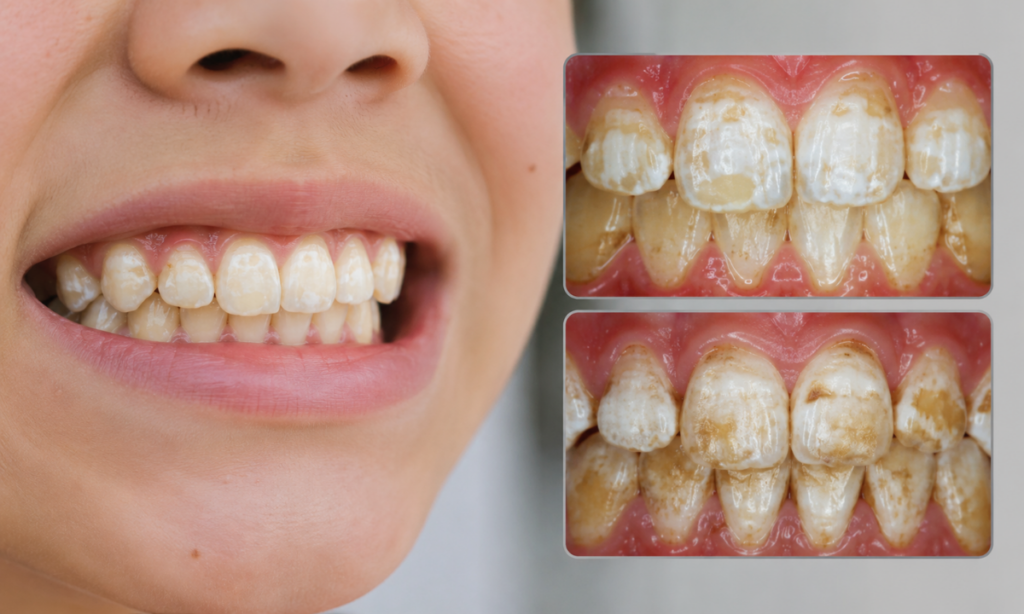
When identifying the visual signs of this enamel variation, dental professionals evaluate a wide spectrum of changes rather than a single type of mark. The presentation of fluorosis of teeth can vary significantly from person to person, ranging from nearly imperceptible pearly flecks to distinct color shifts. Understanding these variations helps you accurately recognize what is happening on your enamel surface.
As this condition occurs uniformly during early childhood development, it follows specific patterns that distinguish it from standard surface stains or early cavities.
Key Visual Indicators to Look For
1. Bilateral Symmetry: This condition almost always affects teeth symmetrically across the dental arch. If you notice a faint white line on your left central incisor, a highly similar, matching pattern will typically be present on your right central incisor.
2. Intact Enamel Texture: In the vast majority of cases, the affected areas remain hard, glassy, and completely smooth to the touch. Unlike early decay, which leaves the tooth surface feeling soft or sticky under a dental instrument, mild enamel variations retain their structural resilience.
3. The Dry-Tooth Effect: Very mild variations are often completely invisible when the teeth are wet with saliva. They typically become noticeable only when the tooth surface is dried, appearing as faint, paper-white ribbons running horizontally across the biting edges.
Classification of Enamel Variations
| Severity Stage | Visual Characteristics | Enamel Surface Integrity
|
|---|---|---|
| Very Mild to Mild | Fine, opaque white lines or small, paper-white spots covering less than half of the tooth surface. | Completely smooth, hard, and highly resistant to daily wear. |
| Moderate | Widespread chalky-white patches covering more than 50% of the enamel, occasionally accompanied by light tan or cream-colored shading. | Structurally solid, but the tooth loses its natural translucent qualities. |
| Severe | Prominent brown or rust-colored stains with physical pits, grooves, or a noticeably rough, unpolished appearance. | Highly porous surface layer that requires active cosmetic reinforcement to prevent chipping. |
Aesthetic Restorations with Modern Advanced Fluorosis of Teeth Treatment
When planning an aesthetic update for your smile, you have access to a variety of innovative options. Today’s cosmetic dentistry has evolved significantly, shifting away from aggressive drilling toward minimally invasive, enamel-preserving techniques.
Choosing the right teeth fluorosis treatment depends entirely on the depth and severity of the enamel variations, allowing your dental team to customize a plan that restores a natural, uniform look to your teeth.
Depending on whether your teeth feature mild white texturing or deep mineral changes, several modern clinical pathways can help enhance your smile:
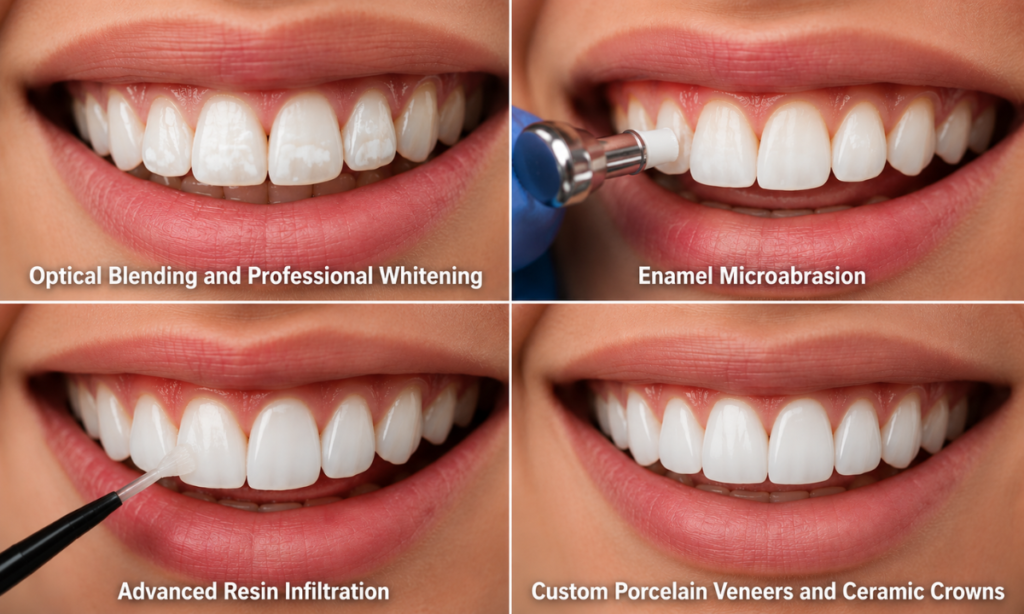
1. Optical Blending and Professional Whitening
For very mild cases where faint white streaks are the primary concern, standard teeth whitening can provide an effective solution. Rather than removing the white spots, a carefully monitored bleaching process gently lightens the surrounding healthy enamel.
This reduces the contrast between the porous variations and the rest of the tooth, blending the shades to create a brighter, more balanced appearance.
2. Enamel Microabrasion
When surface stains or white patches sit primarily on the outermost layer of the tooth, microabrasion offers a conservative fix. Your dentist applies a specialized compound containing mild acids and fine polishing particles to gently lift away a microscopic layer of the affected enamel. This reveals the highly mineralized, uniformly colored enamel underneath, often eliminating superficial marks in a single visit.
3. Advanced Resin Infiltration
For moderate cases, resin infiltration represents a breakthrough in drill-free dentistry. Your dentist applies a specialized, clear liquid resin directly to the dried tooth surface. As the material is highly fluid, it penetrates deep into the porous gaps of the enamel via capillary action.
Once hardened with a curing light, the resin fills the internal gaps, changing how light reflects through the tooth so that white spots blend seamlessly with the surrounding enamel.
4. Custom Porcelain Veneers and Ceramic Crowns
In severe cases where deep brown discoloration or physical pitting has compromised the texture of the tooth, advanced restorations provide a complete transformation.
Custom-fabricated porcelain veneers, thin, durable shells of high-grade dental ceramic, are bonded to the front of the teeth. This completely conceals structural variations while allowing your dental specialist to design the ideal shape, alignment, and color for a confident smile.
Why Choose DDC Smiles?
Achieving a uniform, confident smile requires a combination of exact diagnostics and specialized aesthetic care. If you are seeking an expert evaluation for enamel variations or routine cosmetic enhancements, choosing a trusted dental clinic in HSR Layout ensures you have access to personalized, comprehensive oral healthcare.
We design our diagnostic and clinical pathways to be completely seamless, focusing on comfort and precision:
1. On-Site Advanced Imaging: Equipped with high-fidelity digital OPG and CBCT setups to track the exact depth of enamel mineral shifts instantly.
2. Multispeciality Medical Panel: Over 12 specialized MDS doctors working together to craft customized cosmetic and restorative treatment plans.
3. Enamel-Preserving Modalities: Prioritizing conservative procedures like resin infiltration and microabrasion to safeguard your natural tooth structure.
4. Transparent Financial Pathways: Open, tiered pricing models and flexible payment plans to make premium cosmetic dentistry highly accessible.
Similarly, our long-standing Dental clinic in Koramangala brings decades of clinical experience right to your neighborhood, eliminating the need to visit external diagnostic labs before beginning your aesthetic journey.
Conclusion
Enamel variations like childhood-induced staining are not a reflection of poor hygiene or dynamic oral decay; they are simply structural markers from your body’s developmental years. As these superficial marks leave the core strength of your smile completely intact, addressing them is a purely aesthetic choice aimed at unlocking your natural confidence.
With modern cosmetic workflows, balancing the tone and texture of your teeth is easier and gentler than ever. Partnering with DDC Smiles allows you to navigate your choices with clarity, transforming surface spots into a smooth, brilliant smile you are proud to share with the world.
Reference:
1. https://www.ncbi.nlm.nih.gov/books/NBK585039/
2. https://en.wikipedia.org/wiki/Dental_fluorosis
