




Blog Content
“How many visits will this take?” is one of the first questions patients ask when a dentist recommends a root canal. The honest answer is: it depends on your tooth, your infection, and the technology your clinic uses. Today, a single sitting root canal treatment can often resolve infected or badly decayed teeth in one appointment — a far cry from the two- or three-visit root canals many people still associate with the procedure.
But single-sitting isn’t automatically the right choice for every case. Some teeth genuinely need multi sitting RCT for the best long-term outcome. This guide breaks down what separates the two approaches, when each one applies, and what to expect if you’re booking a one day root canal in HSR Layout. For the full range of endodontic treatments available, you can also visit our RCT service page.
What Is a Single-Sitting Root Canal Treatment?
A single sitting root canal treatment is exactly what it sounds like: the entire procedure — cleaning the infected pulp, shaping the canal, disinfecting it, and sealing it — is completed in one appointment, usually within 45 minutes to 90 minutes depending on the tooth. This has become possible largely because of modern endodontic technology, including rotary instruments that shape canals faster and more precisely than traditional hand files, apex locators that pinpoint canal length electronically, and 3D imaging that maps the tooth’s internal anatomy before treatment even begins.
Multi sitting RCT, by contrast, spreads the same core steps across two or three visits, usually with a medicated dressing placed inside the tooth between appointments. This isn’t an outdated approach — it remains the safer, more predictable option for certain clinical situations, which we’ll cover below.
Both approaches aim for the same result: removing infected or inflamed pulp tissue and saving the natural tooth. The difference lies in how quickly that result is achieved and which cases are suited to a faster timeline.
When Should You Choose Single-Sitting vs Multi-Sitting RCT?
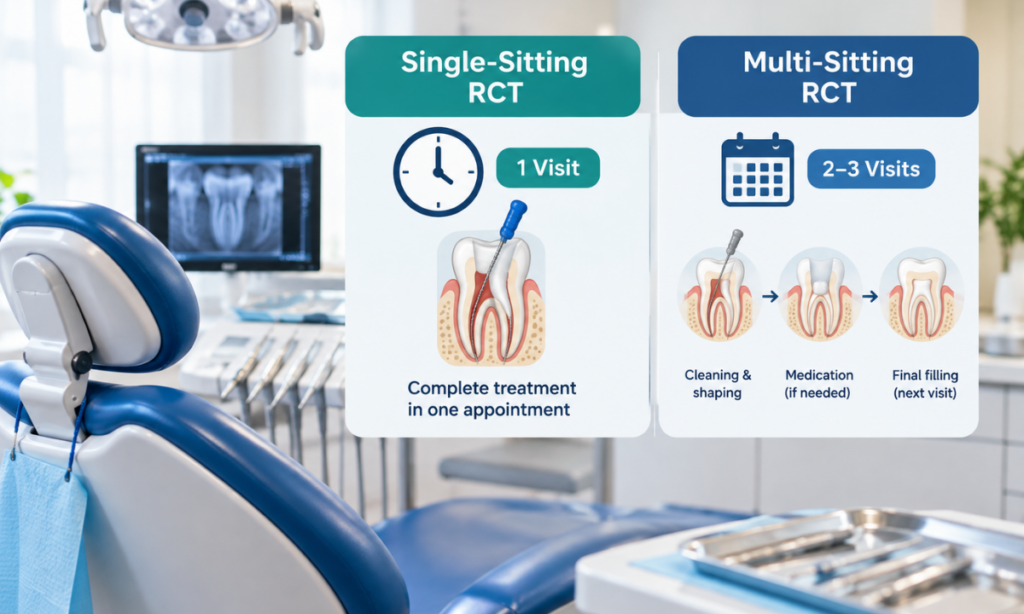
Dentist discussing RCT treatment options with a patient.
The choice between a single sitting root canal treatment and multi sitting RCT isn’t about patient preference alone — it’s primarily a clinical decision based on the condition of the tooth. Here’s how dentists typically decide:
- Mild to moderate infection, no active abscess. Teeth with straightforward canal anatomy, no active swelling, and pulp that can be fully cleaned in one visit are strong candidates for single-sitting treatment.
- Complex root canal anatomy. Curved, narrow, or unusually shaped canals may need more time to clean thoroughly and disinfect properly, making a multi sitting RCT the safer route.
- Active infection or abscess with drainage. If there’s significant swelling, pus discharge, or acute pain from a spreading infection, dentists often prefer to place a medicated dressing first and complete the procedure over multiple visits to let the infection settle.
- Retreatment cases. Teeth being re-treated after a previous root canal has failed are more likely to need multiple sittings, since old filling material must be removed and the canal system re-evaluated.
- Patient scheduling constraints. Someone booking a one day root canal in HSR Layout before travel or a busy work week is a common, valid reason to prioritize single-sitting — as long as the tooth’s condition allows it.
A good clinic will always base the decision on diagnostic imaging and clinical examination first, and explain honestly if your case is better suited to a multi sitting RCT rather than pushing everyone toward the faster option.
Where to Get Reliable Single-Sitting RCT (HSR Layout)
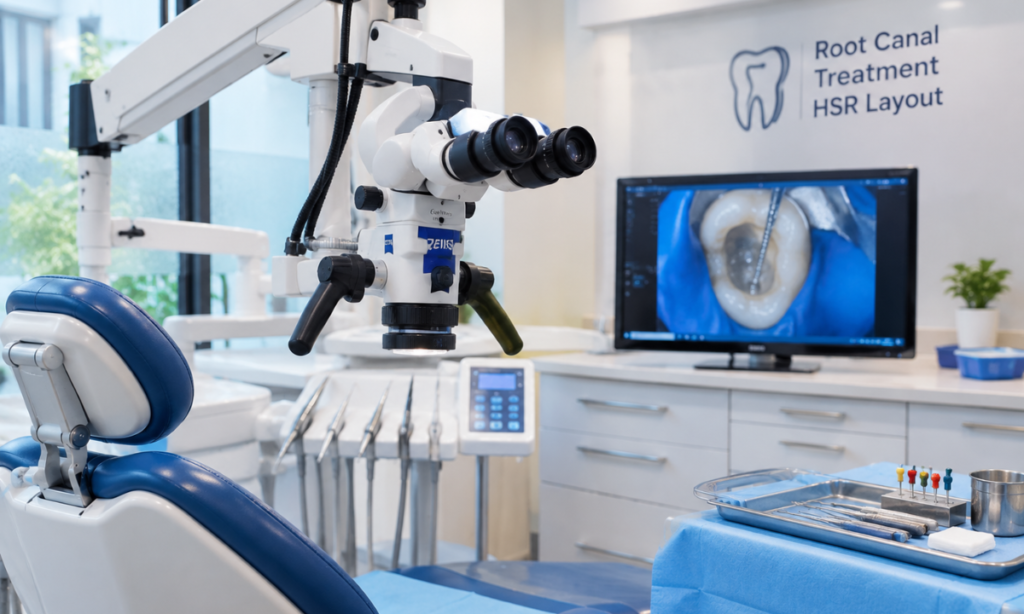
Single-sitting RCT at a dental clinic in HSR Layout.
Not every clinic offering a “one day root canal” actually has the infrastructure to deliver it safely. Rushing a multi-canal molar into a single visit without the right equipment can lead to incomplete cleaning and a higher chance of reinfection. When choosing a clinic for a one day root canal in HSR Layout, look for:
- Modern endodontic technology on-site. Rotary systems, apex locators, and digital X-rays specifically built for endodontic precision — not just general dental equipment.
- Access to a dental operating microscope. An operating microscope allows the dentist to see fine canal details, locate additional canals that are easy to miss, and clean more thoroughly — all of which support safe single-visit treatment.
- Documented experience with single-sitting cases. A dentist who has completed a meaningful number of single sitting root canal treatments will be faster and more consistent than one attempting it occasionally.
- A clear approach to pain management. Reliable local anesthesia protocols and a calm, communicative chairside manner are what actually make a painless root canal procedure possible — not just the equipment.
A clinic that combines this technology with clinical judgment — recommending multi sitting RCT when a tooth genuinely needs it — is a far better long-term choice than one that markets every case as a quick, one-visit fix.
How the Treatment Works: Single-Sitting vs Multi-Sitting Process
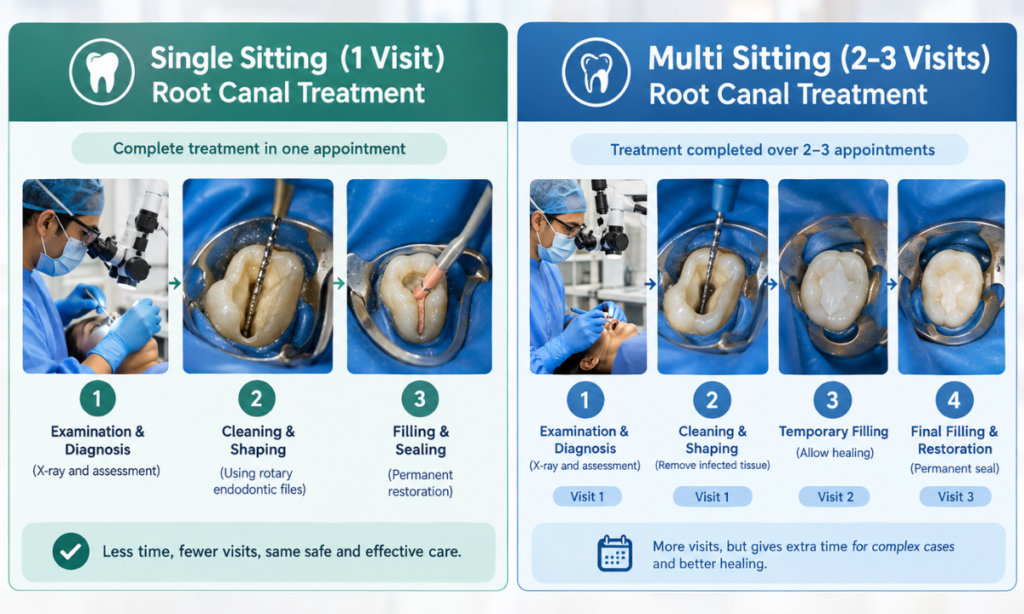
Comparing single-sitting and multi-sitting RCT procedures.
Both approaches follow the same broad root canal treatment steps — the difference is how those steps are distributed across appointments.
- Diagnosis and imaging. A digital X-ray or 3D scan maps the tooth’s canal anatomy and confirms the extent of infection or decay.
- Anesthesia. Local anesthesia numbs the area completely, which is the foundation of any painless root canal procedure, regardless of how many visits it takes.
- Access opening. A small opening is made in the tooth to reach the infected pulp chamber and canals.
- Cleaning and shaping. Infected or inflamed tissue is removed using rotary instruments, and the canals are shaped and disinfected. In a single sitting root canal treatment, this is completed fully in one visit; in multi sitting RCT, a medicated dressing is placed and the tooth is temporarily sealed until the next appointment.
- Obturation (filling the canal). The cleaned canals are filled with a biocompatible material (commonly gutta-percha) to seal them permanently and prevent reinfection.
- Final restoration. A crown or filling is placed to restore the tooth’s strength and function, since a root-canal-treated tooth can become brittle over time without it.
For multi sitting RCT, steps 4 through 6 are simply spread across two or three appointments instead of one, giving the tooth time to respond to the medicated dressing before it’s permanently sealed. Neither path skips steps — they just differ in pacing, which is exactly why the right choice depends on the tooth, not just convenience.
Frequently Asked Questions
A few quick answers to what patients commonly ask before booking either approach:
Is a single-sitting RCT more painful than a multi-sitting one?
Not on its own. What makes a painless root canal procedure possible is proper anesthesia and a gentle technique — both single-sitting and multi-sitting treatments should be equally comfortable when done correctly. Any lingering soreness afterward is usually mild and manageable with over-the-counter pain relief.
How long is recovery after a one day root canal?
Most patients can eat and work normally the same day, though it’s best to avoid chewing on the treated tooth until the final crown or filling is placed. A tooth left without its final restoration for too long is more vulnerable to fracture, regardless of how many sittings the root canal itself took.
Can a single-sitting RCT turn into a multi-sitting one mid-treatment?
Yes, in many cases. If your dentist begins the procedure expecting a single-sitting treatment but discovers unexpected complexity — an extra canal, unusual curvature, or persistent infection — it’s safer to convert to a multi sitting RCT than to rush the remaining steps.
Does a single-sitting RCT cost more than a multi-sitting one?
Pricing depends more on the tooth’s complexity (number of canals, whether it’s a molar or incisor) and the technology used than strictly on the number of sittings. Ask your clinic for a written estimate after the diagnostic X-ray, before treatment begins.
Making the Right Choice for Your Tooth
There’s no universally “better” option between single sitting root canal treatment and multi sitting RCT — there’s only the option that’s right for your specific tooth. A straightforward case with modern endodontic technology and an experienced dentist can often be resolved comfortably in one visit. A more complex infection deserves the extra time a multi sitting approach provides, even if it means a second appointment.
If you’re weighing your options or need a one day root canal in HSR Layout, the best next step is a proper diagnostic exam rather than a decision made over the phone. Visit our RCT service page to see how DDC Smiles evaluates each case and matches it to the safest, most comfortable treatment path.
Reference:
https://healthcare-bulletin.co.uk/article/outcomes-of-single-visit-versus-multi-visit-root-canal-therapy-a-meta-analysis-of-success-rates-2756/
