

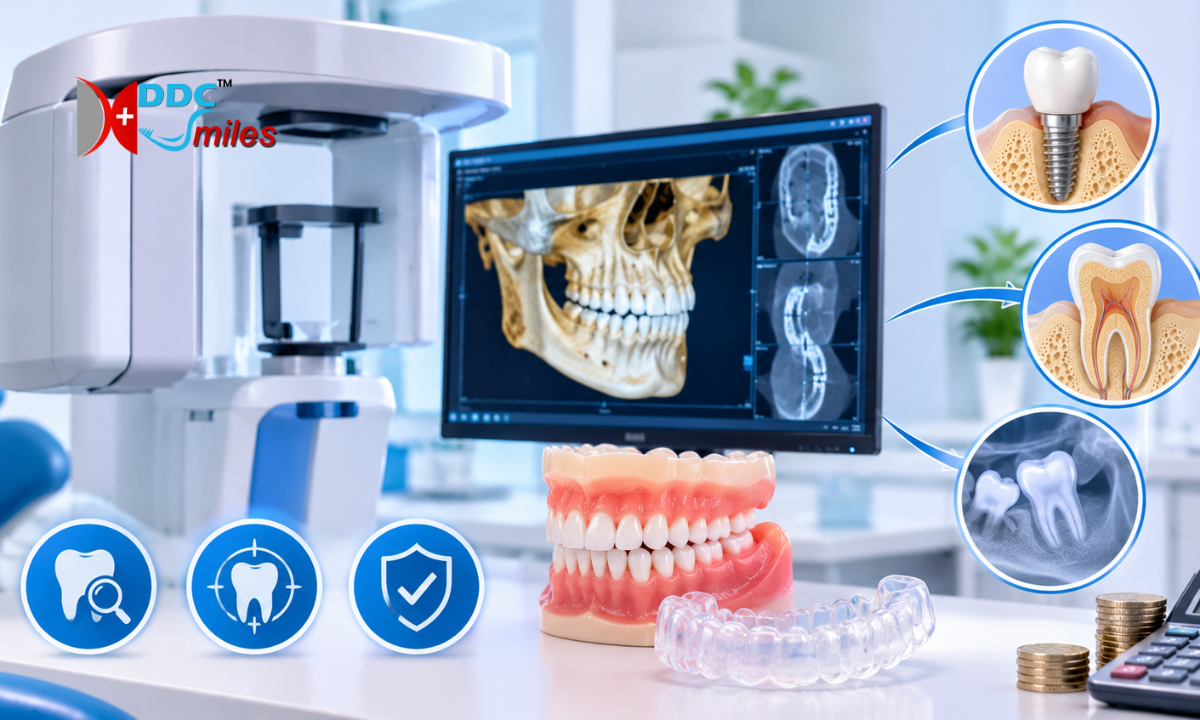
3D dental imaging in Bangalore helps dentists examine teeth, jawbones, and surrounding structures in three dimensions when conventional dental X-rays do not provide enough information. One of the technologies used for this purpose is cone beam computed tomography, commonly known as a CBCT scan.
Unlike a conventional dental X-ray, which produces a two-dimensional image, a CBCT scan creates a three-dimensional view of the selected area. This can help dentists assess complex dental conditions and plan certain procedures, including dental implant placement, root canal treatment, and oral surgery.
At DDC Smiles, patients can enquire about 3D dental imaging and CBCT scans in Bangalore. The clinic’s published price list includes different scan options based on the area being examined.
Need a 3D dental scan? Contact DDC Smiles to enquire about scan availability, pricing, and appointment arrangements.
What Is 3D Dental Imaging?
3D dental imaging is a diagnostic imaging method that allows dentists to view selected teeth, jawbones, and other oral and maxillofacial structures in three dimensions.
In dentistry, one commonly used technology is cone beam computed tomography (CBCT). During a CBCT scan, the machine rotates around the patient’s head and captures imaging data that specialised software reconstructs into a three-dimensional image.
The dentist can review the resulting images from different angles to assess anatomical structures relevant to diagnosis and treatment planning.
CBCT does not replace every type of dental X-ray. It is generally recommended when the additional three-dimensional information is likely to help answer a specific clinical question.
What Is a CBCT Scan Used for in Dentistry?

A CBCT scan may be recommended when a dentist needs more detailed information about the teeth, jawbone, or surrounding anatomy than conventional imaging can provide.
1. Dental Implant Planning
Before placing a dental implant, the dentist needs to assess the available bone and the relevant anatomical structures.
A CBCT scan can help evaluate bone dimensions and the position of nearby structures, supporting decisions about implant placement and treatment planning.
Explore the dental services offered by DDC Smiles to learn more about the clinic’s dental care options.
2. Root Canal Assessment
Some root canal cases involve complex root anatomy, unusual canal configurations, persistent symptoms, or suspected problems that are difficult to assess using conventional images alone.
In selected cases, CBCT may provide additional information to support diagnosis and treatment planning. It is not routinely necessary for every root canal treatment.
3. Wisdom Tooth Evaluation
An impacted wisdom tooth may lie close to important anatomical structures, including the nerve canal in the lower jaw.
When conventional X-rays do not provide sufficient information, a CBCT scan may help the dentist assess the tooth’s position and its relationship to surrounding structures before surgery.
4. Jawbone Assessment
Three-dimensional imaging can help evaluate selected jawbone conditions, anatomical variations, and areas requiring further investigation.
The scan may also support planning for certain oral surgical procedures.
5. Impacted or Unusually Positioned Teeth
CBCT can help determine the position of teeth that have not erupted normally, particularly when their relationship to neighbouring teeth or other structures is important for treatment planning.
6. Selected Complex Dental Conditions
Some complex dental or maxillofacial conditions require additional imaging to clarify anatomy or support clinical decisions.
The dentist determines whether CBCT is appropriate based on the clinical examination, symptoms, previous imaging, and the specific diagnostic question.
What Is the Cost of a 3D Dental Scan in Bangalore?
The cost of a 3D dental scan depends on the area being scanned and the imaging required. A scan of one tooth generally costs less than a scan covering an entire dental arch or the full mouth.
DDC Smiles publishes the following CBCT scan prices on its website.
| CBCT Scan Type | Published Price at DDC Smiles |
| Single-tooth scan | ₹900 |
| Two-teeth scan | ₹1,200 |
| One-quadrant scan | ₹1,500 |
| One-arch scan | ₹1,800 |
| Full-mouth scan | ₹2,800 |
Prices are based on the published DDC Smiles CBCT price list. Confirm the current charges, scan coverage, and any additional fees directly with the clinic before booking.
You can check the DDC Smiles dental CBCT page for information about its imaging service and published prices.
What Affects the Cost of 3D Dental Imaging?
Several factors can influence the final cost.
- Area being scanned: A small region and a larger scan have different imaging requirements.
- Clinical purpose: The dentist selects the appropriate scan based on the condition being assessed.
- Image interpretation: Ask whether the quoted fee includes image review or a formal radiology report.
- Additional requirements: Further consultations or other diagnostic tests may involve separate charges.
- Clinic and equipment: Pricing can vary between providers and imaging centres.
The appropriate scan should be selected according to clinical need rather than price alone.
3D Dental Scan vs Conventional Dental X-Ray
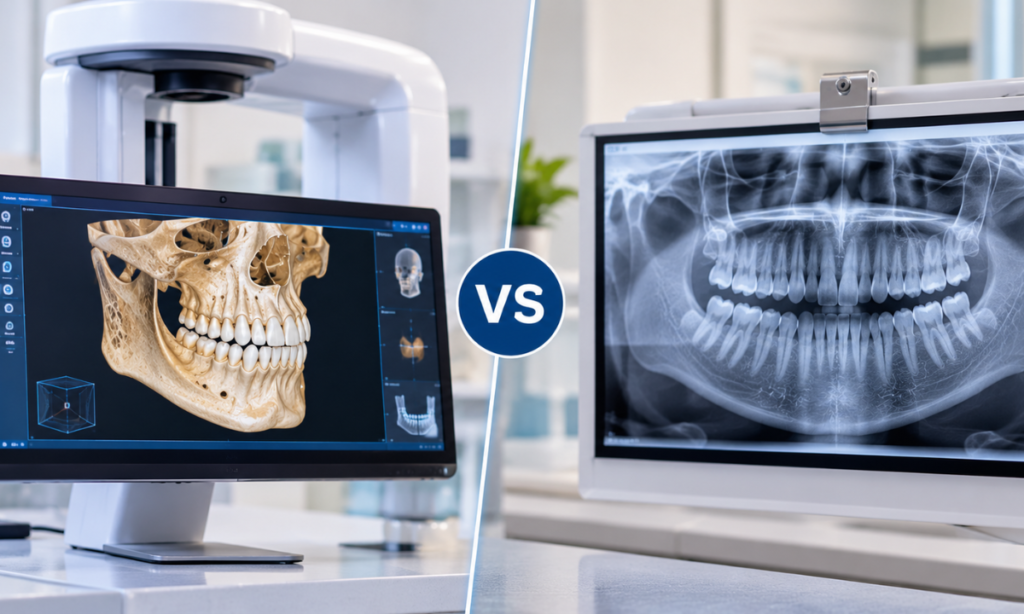
Both conventional dental X-rays and CBCT scans help dentists assess oral health, but they provide different levels of information.
| Feature | Conventional Dental X-Ray | 3D Dental Imaging (CBCT) |
| Image type | Primarily two-dimensional | Three-dimensional |
| Radiation exposure | Generally lower, depending on the image | Generally higher than conventional dental X-rays |
| Detailed jawbone assessment | Limited by the image type | Provides three-dimensional views of the scanned region |
| Dental implant planning | May provide some useful information | Can help assess bone dimensions and relevant anatomy |
| Root and canal assessment | Useful for many routine cases | May provide additional information in selected complex cases |
| Scan coverage | Depends on the X-ray type | Selected area, arch, or larger region, depending on the machine |
| Routine use | Common when clinically indicated | Reserved for cases where 3D information is justified |
A CBCT scan is not automatically better for every dental problem. Conventional dental X-rays may provide sufficient information for many routine examinations.
The dentist should choose the imaging method that answers the clinical question with the least necessary radiation exposure.
Is 3D Dental Imaging Safe?
CBCT uses X-rays, which are a form of ionising radiation. Although dental CBCT generally involves less radiation than many conventional medical CT examinations, it usually involves more radiation than standard dental X-rays.
For this reason, a CBCT scan should be performed only when the expected diagnostic benefit justifies the exposure.
Dentists can help minimise unnecessary exposure by:
- Recommending scans based on individual clinical needs.
- Reviewing previous dental images when available and appropriate.
- Selecting the smallest scan area that provides the necessary information.
- Using suitable exposure settings for the patient and clinical purpose.
- Avoiding unnecessary repeat scans.
Children and adolescents require particular consideration because they are more sensitive to radiation than adults.
If you are pregnant or think you may be pregnant, tell your dentist before imaging so the need for the scan and appropriate precautions can be assessed.
For more information about dental imaging and radiation safety, refer to the American Dental Association’s guidance on dental X-rays.
What Happens During a CBCT Scan?
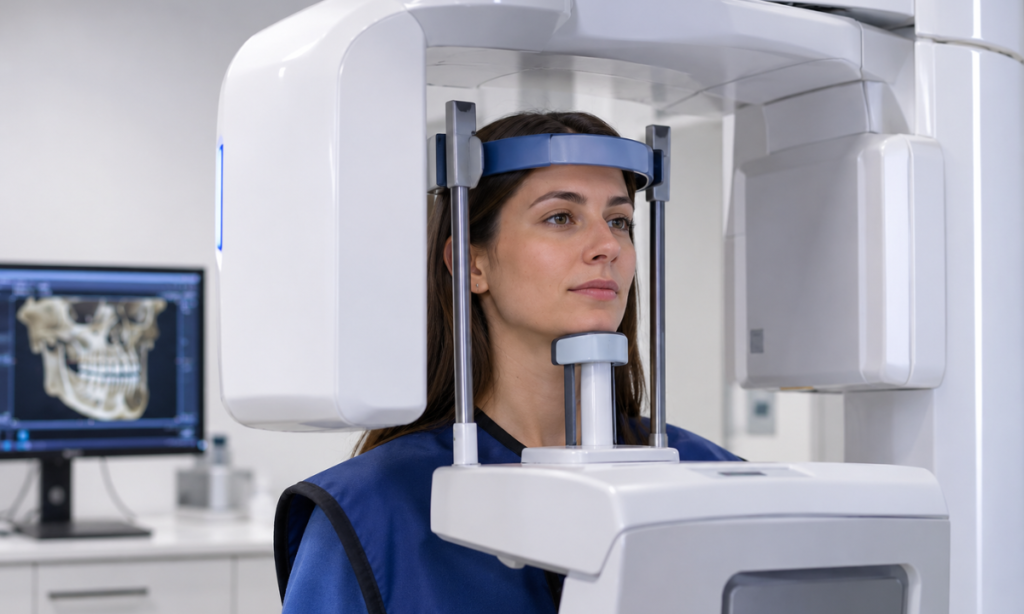
A dental CBCT scan is generally a quick, non-invasive imaging procedure. The exact process depends on the equipment and the area being examined.
Step 1: Review of Your Dental Needs
The dentist reviews your symptoms, clinical examination, and previous images, if available, to determine whether three-dimensional imaging is necessary.
Step 2: Preparation
You may be asked to remove metal objects around the head and neck that could interfere with the image.
Follow the instructions provided by the imaging team.
Step 3: Positioning
The dental imaging professional positions you correctly in or around the scanner, depending on the machine design.
You may be asked to remain still while the machine rotates around your head.
Step 4: Image Capture
The scanner captures imaging data from the selected region. The procedure is usually painless and does not require an injection.
Step 5: Image Review
The resulting images are reconstructed using specialised software. The dentist or appropriate imaging professional reviews them to assess the structures relevant to the clinical question.
Step 6: Treatment Planning
If the scan provides the necessary information, the dentist uses the findings alongside your clinical examination and other relevant records to plan the next steps.
Does a 3D Dental Scan Hurt?
No. A CBCT scan is generally painless because it does not involve cutting, drilling, or inserting instruments into the teeth.
You simply need to remain still while the images are captured. The time required varies by equipment and scan type.
If you have difficulty standing, sitting still, or maintaining a particular position, tell the imaging team before the procedure.
Who Needs a 3D Dental Scan?
Not everyone needs three-dimensional dental imaging.
A dentist may recommend CBCT when additional anatomical information is important for a specific diagnosis or procedure, such as:
- Planning selected dental implant procedures.
- Evaluating certain impacted teeth.
- Investigating complex root anatomy.
- Assessing selected jawbone conditions.
- Planning particular oral surgical procedures.
- Investigating complex dental problems when conventional images are insufficient.
For routine check-ups, many cavities, and other common dental conditions, a clinical examination and conventional imaging may be sufficient.
The decision should be based on your individual dental needs.
3D Dental Imaging at DDC Smiles, Bangalore
DDC Smiles provides information about its dental CBCT imaging service, including scan options and published prices, on its website.
The DDC Smiles dental CBCT page provides information about the imaging service, while the facilities page lists the clinic’s dental technology and facility information.
Dental CBCT in Koramangala, Bangalore
Patients looking for a 3D dental scan in Koramangala, Bangalore, can contact DDC Smiles to enquire about CBCT availability, scan coverage, and appointment arrangements.
The clinic lists its dental CBCT service at its Koramangala location. Confirm the current availability and price for your required scan before visiting.
For appointment enquiries, visit the DDC Smiles contact page.
Dental Care in HSR Layout, Bangalore
Patients looking for a dental clinic in HSR Layout, Bangalore, can contact DDC Smiles to enquire about dental consultations and available services.
If your dentist recommends a CBCT scan, ask the clinic where the scan will be performed and whether any referral or prior appointment is required.
Visit the DDC Smiles homepage for general information or use the contact page to make an enquiry.
Frequently Asked Questions About 3D Dental Imaging
1. What is a 3D dental scan?
A 3D dental scan is an imaging examination that creates a three-dimensional view of selected teeth, jawbones, and surrounding structures. CBCT is a commonly used technology for this purpose.
2. How much does a CBCT scan cost in Bangalore?
The published DDC Smiles prices range from ₹900 for a single-tooth scan to ₹2,800 for a full-mouth scan. The actual charge depends on the scan required. Confirm the current price directly with the clinic.
3. Is a CBCT scan the same as a dental CT scan?
CBCT is a specialised form of computed tomography used in dentistry. It produces three-dimensional images of selected oral and maxillofacial structures. It differs from conventional medical CT in its imaging technology and typical applications.
4. Is 3D dental imaging better than a normal dental X-ray?
It provides additional three-dimensional information, but it is not necessary for every patient. Conventional dental X-rays may be sufficient for many routine conditions. CBCT is recommended when the additional information is expected to support diagnosis or treatment planning.
5. Is a CBCT scan safe?
CBCT involves ionising radiation. It should be recommended only when clinically justified, using appropriate settings and the smallest scan area that meets the diagnostic need.
6. How long does a 3D dental scan take?
Image acquisition is usually quick, but the overall appointment may take longer because of preparation and positioning. The exact time depends on the equipment and scan type.
7. Is a CBCT scan necessary before dental implants?
CBCT may be recommended for implant planning because it provides three-dimensional information about bone dimensions and relevant anatomical structures. The need for imaging depends on the individual case and the dentist’s assessment.
8. Can a CBCT scan detect every dental problem?
No. CBCT provides detailed anatomical information, but it does not detect every condition or replace a clinical examination. The dentist interprets the images alongside symptoms, examination findings, and other diagnostic information.
9. Do I need a referral for a 3D dental scan?
Requirements vary by clinic and the reason for imaging. Contact the imaging centre to confirm whether a dentist’s prescription, referral, or prior consultation is required.
10. Where can I enquire about a 3D dental scan in Bangalore?
You can contact DDC Smiles to enquire about its CBCT service, scan options, pricing, and appointment availability.
Conclusion
3D dental imaging in Bangalore can provide valuable information when dentists need a three-dimensional view of the teeth, jawbones, or surrounding anatomy. CBCT may support selected dental implant procedures, complex root canal assessments, impacted-tooth evaluation, and oral surgical planning.
At DDC Smiles, the published CBCT scan prices range from ₹900 for a single-tooth scan to ₹2,800 for a full-mouth scan. Confirm current charges and the required scan coverage with the clinic before booking.
Because CBCT uses ionising radiation, it should be recommended only when the additional information is clinically justified.
To learn more about the service or enquire about an appointment, visit the DDC Smiles dental CBCT page or contact the clinic.
Reference:
1)https://www.ada.org/resources/ada-library/oral-health-topics/x-rays-radiographs
