

It is one of the questions I hear most often in consultation: “How long will my dental implants last?”
It is a fair question. You are investing time, money and trust in a tooth replacement, so you deserve a straight answer.
Here is mine. With the right planning and care, an implant can last for decades, and in many patients for life.
But that result is never automatic. Bone, gums, habits, health conditions and the skill of the surgical team all play a part.
In this guide, I will explain what shapes implant durability, how to look after your implant at home, what professional visits involve, and which warning signs to act on early.
| QUICK ANSWER: With good care, the titanium implant post can last 25 years or longer, often for life, while the crown on top usually needs replacing after 10 to 15 years. Bone quality, gum health, smoking, bite forces and daily cleaning decide how long yours will last. |
What Are Dental Implants and Why Do They Last So Long?
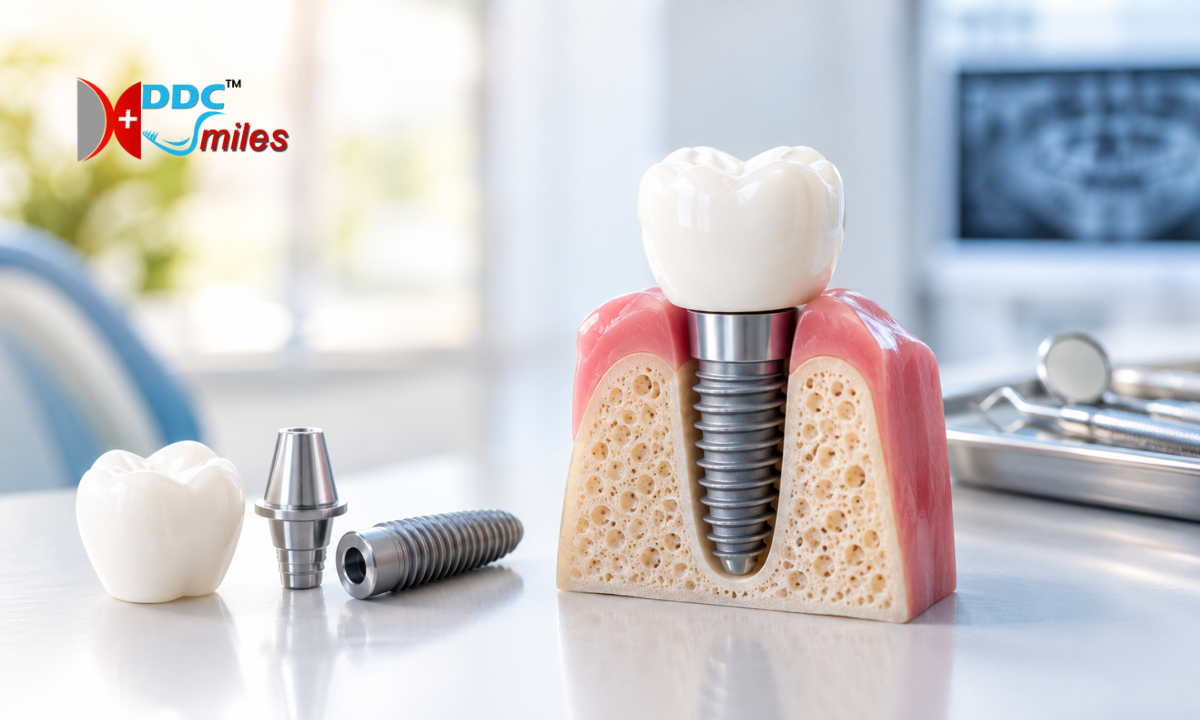
A dental implant is a small titanium post placed in the jawbone to replace the root of a missing tooth. A crown is then fixed on top.
The magic happens in the jaw. Over three to four months, bone grows tightly around the titanium surface. This process is called osseointegration.
| DEFINITION Osseointegration is the biological bonding of living bone to the surface of an implant, which anchors it as firmly as a natural root. |
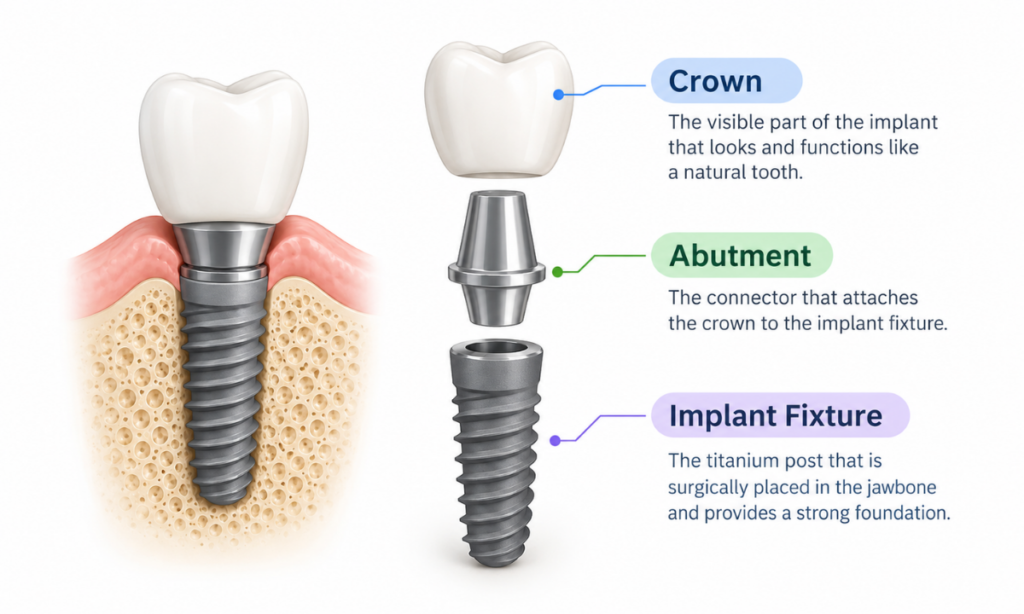
Titanium is biocompatible, which means the body accepts it rather than rejecting it. That is the first reason implants are so durable.
The second reason is function. An implant transmits chewing forces into the jaw, which helps keep the bone stimulated and stable.
A bridge or denture cannot do that. This is why dentists often describe implants as the closest thing to a natural tooth root.
At DDC Smiles, we plan every case with digital imaging and modern implant technology so the post is positioned in healthy bone at the right angle.
So, How Long Do Dental Implants Last in Real Life?
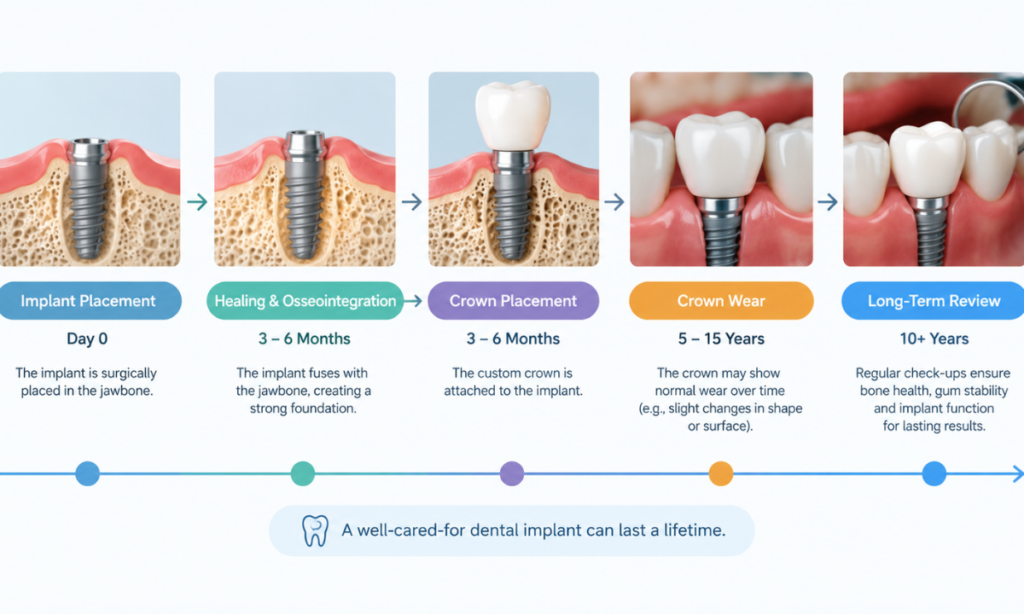
Let me split the answer into two parts, because the post and the crown behave differently.
The implant post, when it has fully integrated and is kept clean, is designed to be a permanent fixture. Many stay stable for 25 years or more.
The crown is a different story. It takes the daily wear of biting, so it may need repair or replacement after 10 to 15 years.
Long-term clinical studies commonly report 10-year survival rates above 90 per cent for implants. The American Dental Association’s MouthHealthy guide gives a useful patient-level overview.
Our own clinic data points the same way. DDC Smiles reports an implant success rate above 98 per cent across our Bangalore clinics, which we attribute to strict sterilisation and high-grade titanium.
| DOCTOR’S TIP A crown wearing out after 12 years is not an implant failure. It is normal maintenance, much like changing tyres on a car that is still running well. |
Here is the catch. “Lasts decades” describes what is possible, not what is guaranteed.
So, what separates the implant that lasts 30 years from the one that struggles at five? That comes down to seven factors.
If you want to understand the treatment stages first, read our guide to the dental implants process.
Seven Factors That Decide Implant Durability
I use a simple checklist with patients. I call it The 7-Factor Longevity Check.
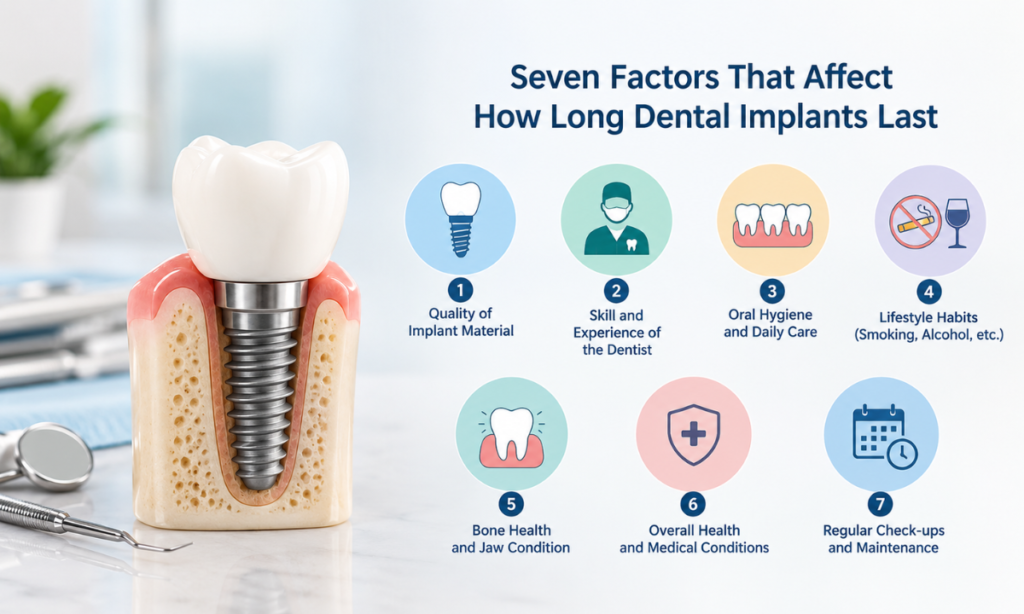
Factor 1: Bone quality and quantity
Implants need enough healthy bone to grip. Thin or soft bone can still work, but it may need grafting first.
A 3D scan shows bone volume and density before we plan anything. Our digital OPG and imaging facilities make this assessment quick and precise.
Factor 2: Gum health
Healthy gums seal around the implant like a collar. Inflamed gums let bacteria travel down to the bone.
Any active gum disease should be treated before placement.
Factor 3: Smoking and tobacco
This is the biggest avoidable risk. Smoking and chewing tobacco reduce blood flow, slow healing and raise the chance of bone loss around the implant.
Factor 4: General health
Well-controlled conditions such as diabetes rarely stop implants from working. Poorly controlled ones slow healing and increase infection risk.
Factor 5: Bite forces and grinding
Night-time grinding, called bruxism, overloads the crown and the screw beneath it. A custom night guard protects your investment.
Factor 6: Planning, implant system and surgical precision
Placement angle, depth and the quality of the implant system all matter. This is the factor you influence by choosing your clinic carefully.
Factor 7: Follow-up and maintenance
An implant that is never reviewed is an implant that is never protected. Regular check-ups catch small problems while they are still small.
| COMMON MISTAKE Treating the implant as “finished” on the day the crown is fitted. Placement is the start of the relationship, not the end. |
Implant Durability by Component
Different parts wear at different speeds. This table shows typical ranges, based on general clinical experience. Individual results vary.
| Component | Typical lifespan | What wears it down | What we check |
|---|---|---|---|
| Titanium post | 25 years to lifelong | Bone loss from infection or overload | Bone level on X-ray |
| Abutment screw | Often lifelong, may loosen | Heavy biting, grinding | Crown stability |
| Porcelain or zirconia crown | 10 to 15 years | Chewing wear, chipping | Surface, bite contact |
| Gum seal around the implant | Depends on hygiene | Plaque, tobacco | Bleeding, probing depth |
Verdict: For most patients, the post outlasts everything else, so protecting the gum and bone around it matters more than anything else.
Note: these are general ranges, not guarantees. Label them “typical clinical ranges” on the page.
Implant Care at Home: A Simple Daily Routine
Good implant care is refreshingly simple. It is very close to caring for natural teeth, with a few extra tools.
I teach patients The 5-Step Daily Implant Care Routine.
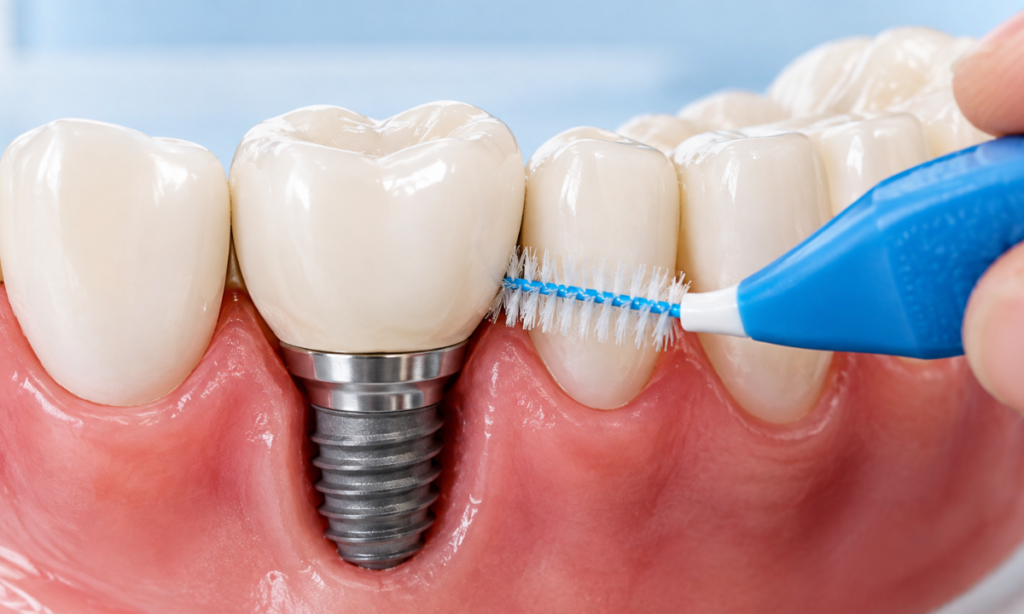
Step 1: Brush twice a day. Use a soft-bristled brush and a non-abrasive toothpaste. Hard bristles can scratch the crown surface.
Step 2: Clean between the teeth. Use interdental brushes or implant-safe floss once a day. This is where most plaque builds up.
Step 3: Add a water flosser. It flushes debris from the gumline and is gentle on the tissue around the post.
Step 4: Rinse smartly. An alcohol-free antibacterial rinse can help, but only when your dentist recommends one.
Step 5: Protect the crown. Never open bottles or tear packets with your teeth. Wear a night guard if you grind.
| VALUE CHECK A few minutes of daily care is a small fraction of the effort involved in treating a failing implant later. |
Daily cleaning is not a replacement for professional visits. Our guide on professional teeth cleaning explains what home routines cannot reach.
Action checklist:
- Replace your toothbrush every three months
- Clean between all teeth, every day
- Keep a night guard beside your toothbrush if you grind
| MID-ARTICLE CTA Worried about an existing implant, or planning a new one? Our team can review your bone health, gum condition and bite before you decide. Book a consultation at DDC Smiles. |
Dental Implant Cleaning at the Clinic: What Happens at Each Visit
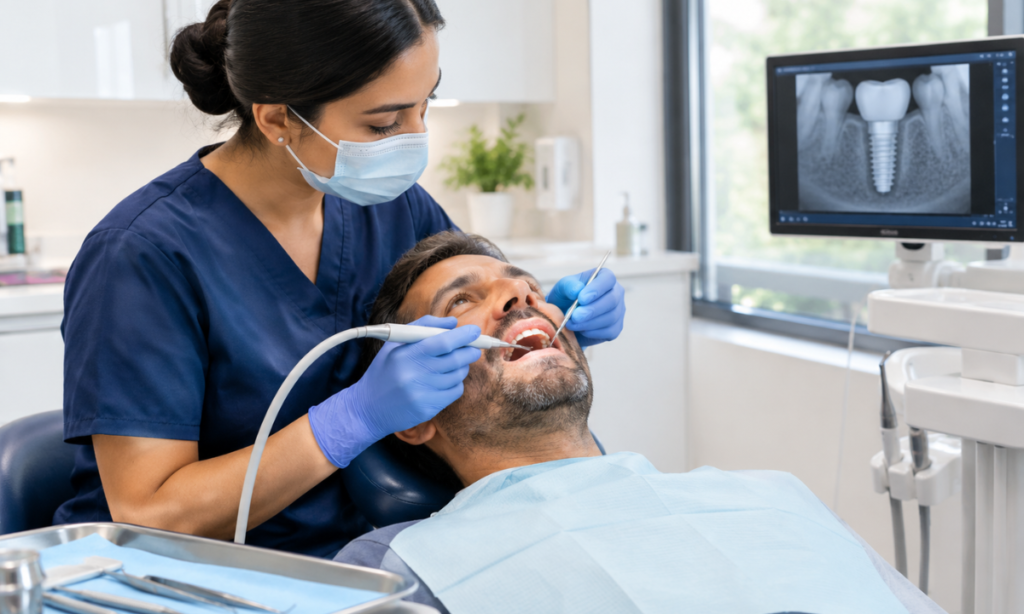
Home care keeps plaque low. Professional dental implant cleaning removes the hardened deposits that brushing cannot.
A typical implant maintenance visit follows a clear order:
- We measure gum pockets around each implant with a gentle probe.
- We check for bleeding, swelling or pus.
- We remove plaque and tartar with implant-safe instruments.
- We polish the crown and check the bite.
- We take an X-ray when needed to monitor bone level.
The table below shows how implant maintenance usually progresses over time.
| Stage | What we check | What you do |
|---|---|---|
| 1 week after crown | Bite, comfort, gum response | Keep the area clean, soft foods |
| 3 months | Gum health, early bone changes | Confirm your home routine |
| 6 months | Cleaning, probing, crown stability | Attend as scheduled |
| Yearly | X-ray, bite review, wear check | Report any changes early |
Verdict: Most patients do well with a review every six months, and your dentist may shorten that if you have gum disease or smoke.
Regular preventive care, which we cover under our dental services, is the most reliable way to extend implant life.
Implant Complications: Warning Signs You Should Never Ignore
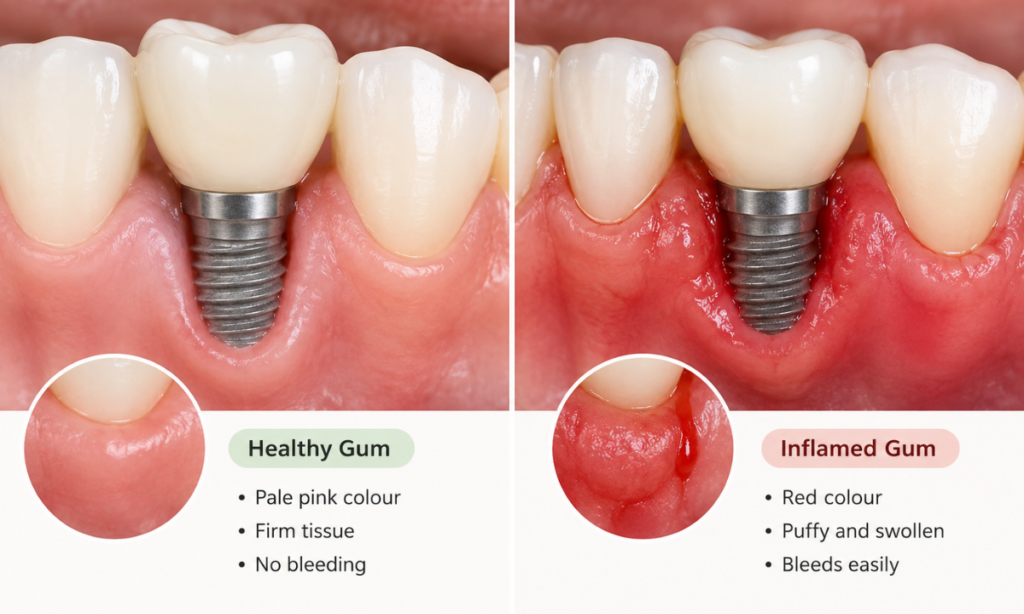
Implants are reliable, but they are not immune to trouble. The good news is that most implant complications are easy to reverse when caught early.
This is inflammation of the gum around the implant, with no bone loss yet. It is reversible with better cleaning and professional treatment.
Peri-implantitis
If mucositis is ignored, infection reaches the bone. Systematic reviews suggest roughly one in five implant patients may be affected at some point, so it is worth taking seriously.
It is the leading cause of late implant failure.
Mechanical problems
A loose crown, a loosened screw or a chipped porcelain surface usually signals overloading. These are fixable, provided you come in promptly.
Early failure
Rarely, an implant fails to integrate in the first few months. It can usually be removed, the site allowed to heal, and a new implant placed.
Call your dentist if you notice:
- Bleeding when you brush around the implant
- Persistent bad taste or bad breath
- Swelling, redness or pus
- A crown that moves or clicks
- Pain that returns after healing
| DOCTOR’S TIP: Do not wait for pain. Implants have no nerve in the post, so pain often appears late. Bleeding gums are the earlier signal. |
Common Mistakes That Shorten Implant Life
I see the same errors again and again. Each one is avoidable.
- Skipping follow-ups. Small gum problems grow into bone loss without anyone noticing.
- Continuing to smoke. Tobacco slowly starves the tissue that holds the implant.
- Cleaning only the crown. Plaque under the gumline is where the damage starts.
- Ignoring night-time grinding. Repeated overload loosens screws and cracks crowns.
- Using abrasive products. Hard brushes and gritty whitening pastes scratch the surface.
- Delaying treatment of bleeding gums. Early inflammation is easy to reverse. Late infection is not.
Putting It All Together
Here is the whole guide as one checklist:
- The implant post can last decades, while the crown typically needs renewing after 10 to 15 years.
- Bone quality, gum health and planning are settled before surgery, so choose your clinic carefully.
- Stop tobacco completely if you want the best long-term result.
- Clean around the implant every day with a soft brush and interdental tools.
- Attend professional cleaning and review visits roughly every six months.
- Wear a night guard if you grind your teeth.
- Report bleeding, swelling or a loose crown early, not late.
Conclusion
So, how long do dental implants last? For most patients who look after them, the answer is decades.
The key word is “look after”. Implants reward consistent habits and regular reviews.
If you are still deciding whether to replace a missing tooth, our page on dental implants in HSR Layout and Koramangala explains how we plan and place them.
If you already have an implant and want it checked, book a review at either of our clinics. A short visit today can protect it for years.
Frequently Asked Questions
How long do dental implants last on average?
The titanium post often lasts 25 years or more, and many last a lifetime with good hygiene and regular reviews. The crown on top typically lasts 10 to 15 years before it needs repair or replacement, depending on your bite and habits.
Can dental implants fail after many years?
Yes, though it is uncommon. Late failure is usually caused by peri-implantitis, which is infection and bone loss around the implant. Poor cleaning, smoking and missed check-ups raise the risk. Early treatment can often stabilise the implant and save it.
How often should I have professional implant cleaning?
Most patients benefit from a review and cleaning every six months. If you have a history of gum disease, smoke, or have diabetes, your dentist may suggest visits every three to four months to keep the tissue around the implant healthy.
Can I use a regular toothbrush and floss on implants?
You can use a soft-bristled toothbrush, but standard floss can shred and leave fibres around the crown. Interdental brushes, implant-safe floss and water flossers clean more effectively. Avoid hard bristles and abrasive toothpaste, which scratch the crown surface.
What are the first signs of implant complications?
Bleeding gums around the implant are usually the earliest sign. Others include swelling, redness, a bad taste, a loose crown or discomfort when biting. Because pain often appears late, do not wait for it before booking a review.
Does a crown replacement mean my implant has failed?
No. Crowns wear like any biting surface, so replacing one after 10 to 15 years is routine. As long as the post remains stable in healthy bone, the implant itself is still doing its job.
Reference:
1.google.com/url?q=https://www.mouthhealthy.org&sa=D&source=docs&ust=1791193192131509&usg=AOvVaw30P1GmKgRVVqZXafYjRNFU
2.https://pmc.ncbi.nlm.nih.gov/articles/PMC11789208/
