


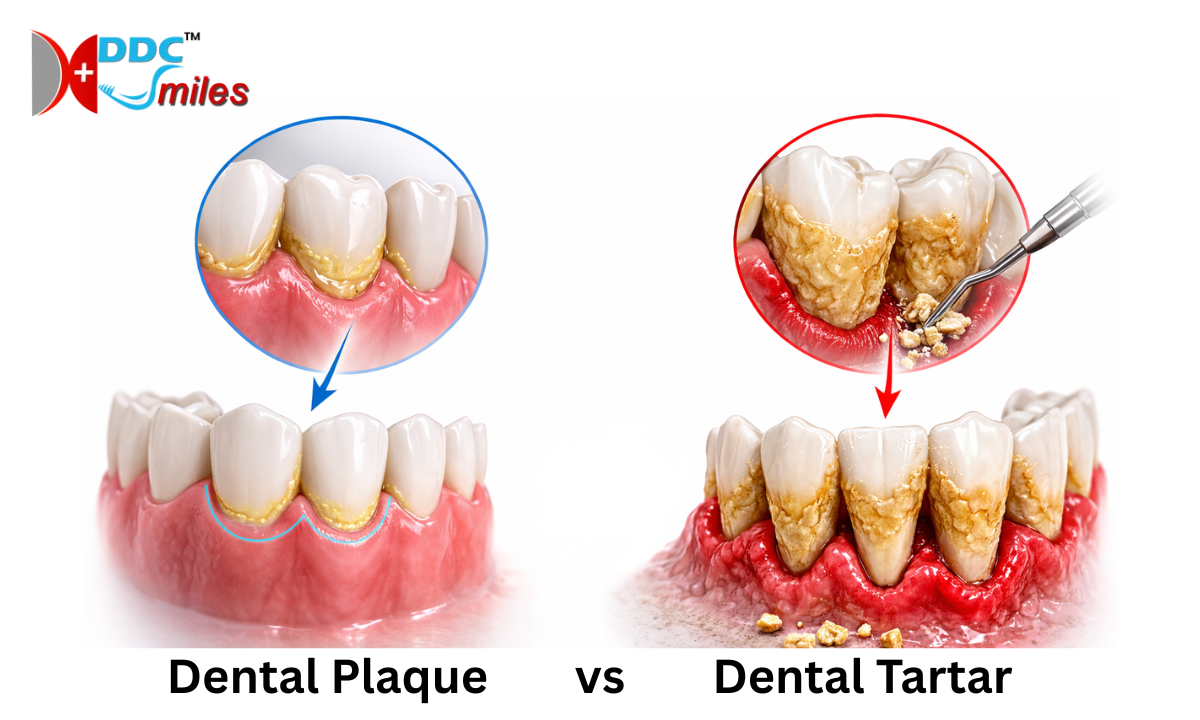
Maintaining a healthy smile requires understanding the exact nature of the threats inside your mouth. Many patients use the terms “plaque” and “tartar” interchangeably, but understanding the battle between dental plaque vs tartar is key to saving your teeth.
If you are seeking care at a Dental Hospital in Koramangala and HSR Layout, our specialists will always evaluate this specific buildup. At DDC Smiles, we see firsthand how confusing these two distinct bacterial stages can be for our patients.
While one is an invisible, sticky film that you can fight at home, the other is a rock-hard, mineralized shield that requires immediate clinical intervention.
Ignoring the difference does not just lead to yellowing teeth: it invites chronic gum inflammation and irreversible bone loss.
In this guide, we will break down exactly what these substances are, how they form, and why professional removal is a non-negotiable part of your healthcare routine.
What is Dental Plaque and Tartar?
To effectively fight oral disease, you must understand what dental plaque and tartar are from a biological perspective. Dental plaque is a sticky, colorless, or pale yellow biofilm that constantly forms on your teeth.
It is composed of bacteria, saliva, and food particles, and it acts as a soft layer that you can actually feel with your tongue when your teeth feel fuzzy. While this soft film is disruptive, the real danger is that it absorbs minerals from your saliva and begins a chemical transformation within just 24 to 72 hours.
This mineralization process causes the soft plaque to harden into a substance known technically as dental calculus, which we commonly call tartar.
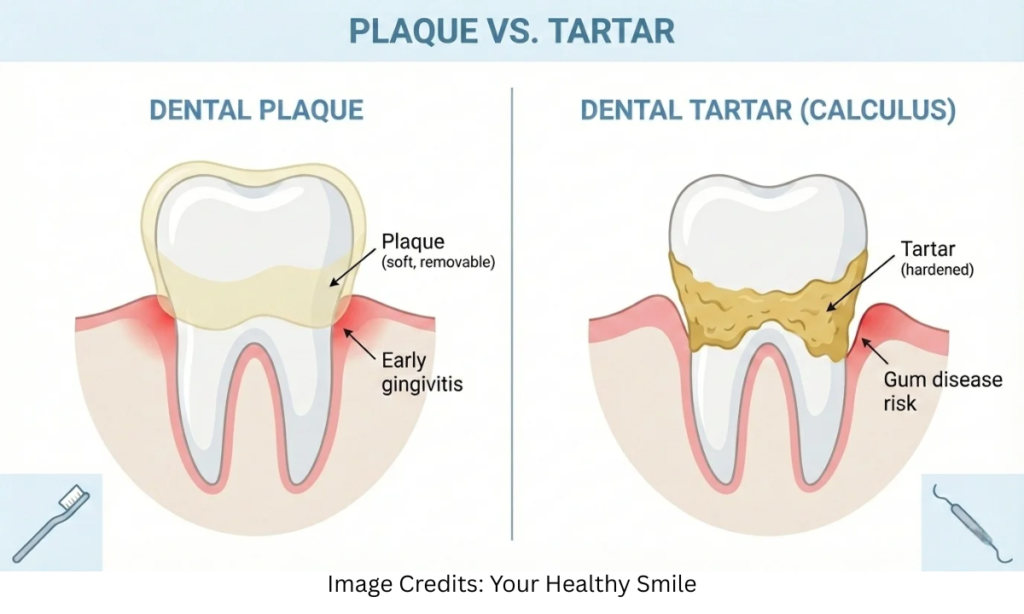
Key Biological Differences:
1. Plaque (Biofilm): A soft, removable bacterial ecosystem that causes mild gum inflammation. It is often invisible but can be detected by its “fuzzy” feel on your teeth.
2. Tartar (Calculus): A hardened, mineralized matrix that is physically bonded to the tooth enamel. It often appears as a yellow, brown, or black stain and acts as a porous surface where new bacteria can easily attach and thrive.
Understanding this biological difference is critical for your home care strategy. While you can maintain an excellent standard of oral hygiene by physically disrupting soft plaque with your toothbrush and floss, you are completely powerless against hardened tartar.
Once the minerals are absorbed, the substance becomes part of the tooth structure, and attempting to remove it at home can damage your enamel or cause gum injury.
How Dental Plaque is Formed
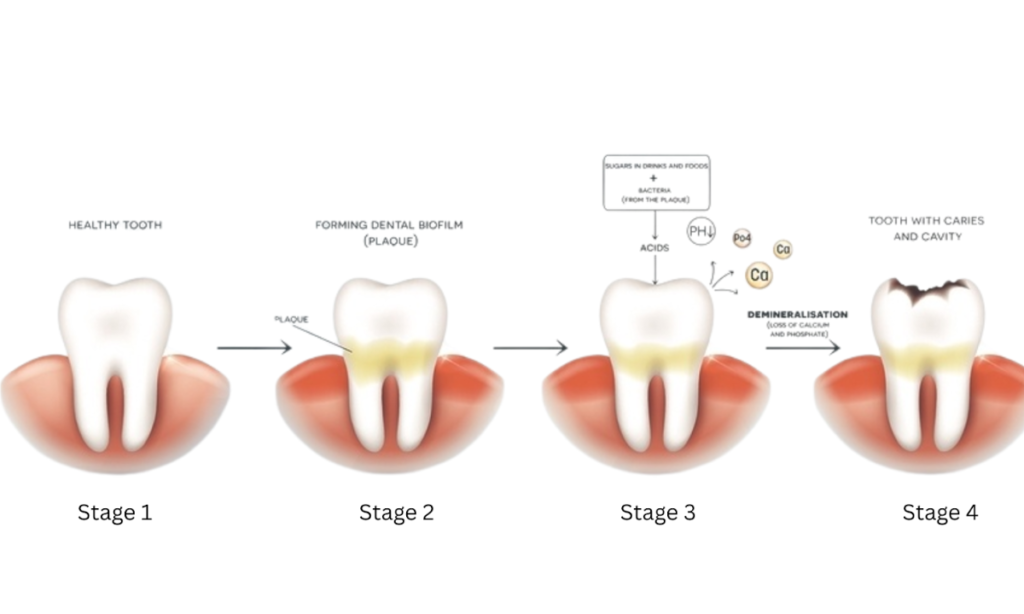
To truly protect your oral health, it is vital to understand the precise timeline of plaque formation at the microscopic level.
The human mouth is an incredibly dynamic ecosystem, and your teeth are never completely sterile. Within seconds after you finish brushing, a thin, invisible coating of salivary proteins called the acquired pellicle forms over your enamel.
While this layer acts as a protective barrier against natural acids, it also serves as the perfect, sticky foundation for bacteria to anchor themselves.
The 4 Stages of Bacterial Colonization
1. Pellicle Formation (0 to 2 Hours): Salivary glycoproteins bind to the clean tooth surface immediately after brushing, preparing the ground for bacterial attachment.
2. Initial Adhesion (2 to 24 Hours): Pioneer bacteria, primarily Streptococcus strains, detect the pellicle and bind to it. They immediately begin multiplying and feeding on the fermentable carbohydrates from your diet.
3. Biofilm Maturation (1 to 3 Days): As the bacteria multiply, they secrete a sticky, slimy substance called an extracellular matrix. This matrix acts like a microscopic fortress, protecting the bacteria from your body’s immune response and rendering most cosmetic mouthwashes ineffective.
4. Acid Production and Mineralization (3+ Days): Safely within their matrix, the bacteria continuously convert dietary sugars into corrosive lactic acid. If this mature plaque is not physically removed, it begins absorbing calcium and phosphate directly from your saliva, which triggers the hardening process into tartar.
Understanding this rapid timeline highlights exactly why dental professionals are so strict about daily hygiene. You are essentially working against a 24-hour biological clock.
If you fail to physically disrupt the biofilm with a toothbrush and dental floss before it matures, the plaque matrix becomes incredibly resilient.
Brushing twice a day is not merely a cosmetic habit: it is a necessary mechanical intervention to break up the bacterial colonies before they can build their protective shield and permanently bond to your enamel.
Is Tartar Worse Than Plaque?
When patients ask if tartar is worse than plaque, the clinical answer is an absolute yes. While plaque initiates the decay process, tartar accelerates and protects it.
Once the soft bacterial biofilm mineralizes into calculus, it creates a rough, highly porous surface that acts like a microscopic coral reef. This hardened shield protects active bacterial colonies from your toothbrush bristles, your dental floss, and even antibacterial mouthwashes.
The bacteria are given a permanent, indestructible home right against your enamel, allowing them to multiply rapidly without any mechanical interference.
To understand the severe escalation of this threat, we must examine how the physical properties and clinical risks change as the bacteria harden.
Table: Dental Plaque vs. Tartar: The Key Differences
| Feature | Dental Plaque | Dental Tartar (Calculus) |
| Texture & Appearance | Soft, sticky, and often an invisible or pale yellow biofilm. | Hard, porous, and cement-like deposit; often stains brown or black. |
| Removability | Easily disrupted and removed at home with brushing and flossing. | Impossible to remove at home; strictly requires professional dental tools. |
| Primary Risk Level | Causes localized enamel demineralization (cavities) and mild gingivitis. | Triggers severe periodontitis, receding gums, and irreversible jawbone loss. |
| Clinical Solution | An improved, strict daily oral hygiene routine. | Professional periodontal scaling and root planing at a dental clinic. |
The most dangerous aspect of tartar is its ability to grow below the gumline. Subgingival calculus actively irritates the gingival tissue, triggering a chronic inflammatory response from your body’s immune system.
As your immune cells rush in to fight the trapped bacteria, they inadvertently begin to break down the surrounding bone and connective tissue that hold your teeth in place. This advanced stage of infection, known as periodontitis, proves exactly why tartar is the ultimate catalyst for permanent tooth mobility and loss.
Why Choose DDC Smiles?
Once plaque mineralizes into tartar, your daily toothbrush becomes entirely useless against it. The biological bond between dental calculus and your tooth enamel is incredibly strong, meaning any attempt to scrape it off at home with DIY tools will only result in severe enamel scratching or permanent gum tissue damage.
At DDC Smiles, we use a specialized, non-surgical periodontal therapy known as scaling and root planning to safely break this bond and restore gum health without damaging the underlying tooth structure.
The Professional Deep Cleaning Process
i. Step 1 (Ultrasonic Scaling): The clinician uses a specialized ultrasonic device that emits high-frequency vibrations and a targeted water stream to shatter the hard tartar deposits above and slightly below the gumline.
ii. Step 2 (Hand Instrumentation): Using precise dental instruments known as scalers and curettes, the dentist meticulously scrapes away any remaining fine calculus from the microscopic crevices of the tooth surface.
iii. Step 3 (Root Planning): The rough surfaces of the tooth roots hidden beneath the gums are smoothed down. This critical step prevents new bacteria from easily reattaching and allows the inflamed gum tissue to heal tightly against the tooth again.
iv. Step 4 (Antimicrobial Irrigation): The deep periodontal pockets are flushed with a medicated, antibacterial solution to eliminate any lingering bacterial colonies and promote rapid tissue recovery.
This professional deep cleaning procedure is the only proven medical method to stop the progression of gum disease once tartar has firmly taken hold. By completely dismantling the hardened bacterial fortress, your immune system can finally stand down, allowing the chronic inflammation to subside.
Following this treatment, patients immediately notice fresher breath, significantly less bleeding while brushing, and a visually brighter smile completely free of dark calculus stains.
Stopping the Plaque Cycle at Home
The ultimate defense against tartar is preventing plaque from staying on your teeth long enough to mineralize. As this hardening process begins in just twenty-four hours, your daily home care routine must be incredibly consistent and highly thorough.
After physically disrupting the bacterial biofilm every single day, you stop the chemical reaction that creates calculus entirely. The American Dental Association (ADA) recommends a strict mechanical approach to keep this sticky film from destroying your enamel.
Your Anti-Calculus Daily Routine
1. Precision Brushing: Brush for a full 2 minutes twice a day using a soft-bristled toothbrush and fluoridated toothpaste to scrub away the soft bacterial biofilm carefully.
2. Interdental Cleaning: Floss at least once daily to physically remove the hidden plaque trapped between your teeth and just below the gumline, where a toothbrush simply cannot reach.
3. Dietary Adjustments: Limit your intake of sticky, sugary, and highly starchy foods, as these carbohydrates serve as the primary fuel for acid-producing bacteria in your mouth.
4. Consistent Hydration: Drink plenty of water throughout the day to naturally wash away leftover food debris and stimulate saliva production to neutralize harmful bacterial acids.
Adhering to this rigorous daily routine ensures that the sticky plaque never has a chance to absorb calcium and phosphate from your saliva.
While these habits are highly effective at preventing tartar formation, they cannot completely replace the need for professional monitoring to catch the microscopic buildup you might inevitably miss.
Conclusion
Understanding the distinct difference between a soft bacterial film and a hardened calcified shield is the first critical step in taking control of your oral health.
While you can successfully manage daily plaque buildup at home, tartar is a permanent threat that strictly requires professional clinical intervention. Allowing calculus to remain bonded to your teeth invites chronic gum inflammation, dangerous periodontal disease, and eventual jawbone loss.
The structural damage caused by this mineralized bacterial fortress is severe, but it is also completely avoidable with regular professional care.
Do not wait until your gums are bleeding or your teeth feel loose to take action against this hardened bacteria. Take the proactive step to protect your smile by scheduling a comprehensive evaluation and professional deep cleaning at DDC Smiles. Visit us today to have your tartar safely removed and your oral health completely reset by our clinical experts. Our specialized team is here to help you maintain a clean, strong, and disease-free smile for years to come.
