

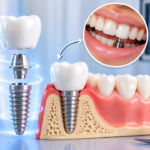

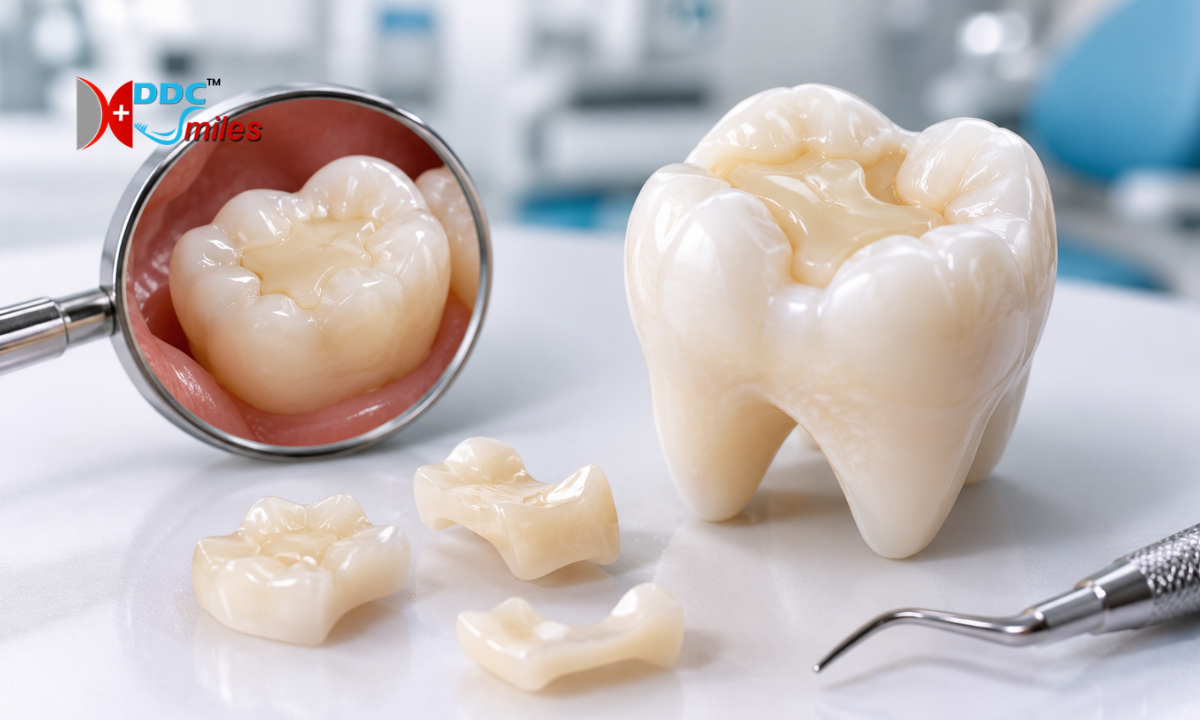
The dental inlay cost in Bangalore depends on the restoration material, the size of the damaged area, and the treatment required to restore the tooth. A ceramic inlay is a custom-made restoration used to repair a tooth when the damage is too extensive for a straightforward filling but does not necessarily require a full dental crown.
According to the published price list of DDC Smiles, a ceramic dental inlay costs ₹10,000–₹12,000 per tooth, while a ceramic onlay is listed at ₹12,000 per tooth. The final treatment plan and cost depend on the dentist’s assessment of the tooth.
If you are considering an inlay and onlay, or another restorative treatment, contact DDC Smiles to discuss your requirements and confirm the current charges.
Dental Inlay Cost in Bangalore: Price List
The cost of an inlay varies depending on the material, the extent of tooth damage, and the treatment needed before the restoration is fitted.
The following prices are based on the published DDC Smiles price list.
| Dental treatment | Published price |
| Ceramic dental inlay | ₹10,000–₹12,000 per tooth |
| Ceramic dental onlay | ₹12,000 per tooth |
These are the listed prices, not a guarantee of the total cost for every patient. Additional procedures may be required depending on the condition of the tooth.
You can review the DDC Smiles price list for the published charges.
What May Be Included in the Dental Inlay Price?
Before proceeding with treatment, confirm with DDC Smiles what the quoted fee includes. Ask whether consultation, digital scanning or impressions, temporary restoration, bonding or cementation, bite adjustment, and follow-up visits are covered.
Additional treatments, such as decay removal, root canal treatment, core build-up, or gum treatment, may be charged separately if needed.
What Is a Dental Inlay?
A dental inlay is a custom-made restoration that fits into a prepared area within a tooth. It is commonly used when damage is too extensive for a conventional filling but the remaining tooth structure can still support an inlay.
Unlike a direct filling, which is placed and shaped inside the tooth during the appointment, an indirect inlay is fabricated separately and then bonded or cemented into position.
Ceramic is one material used for inlays because it can be made to resemble the natural appearance of teeth.
A dentist will assess the extent of decay or damage, the strength of the remaining tooth, and the forces created when you bite before recommending this treatment.
When Is a Dental Inlay Needed?
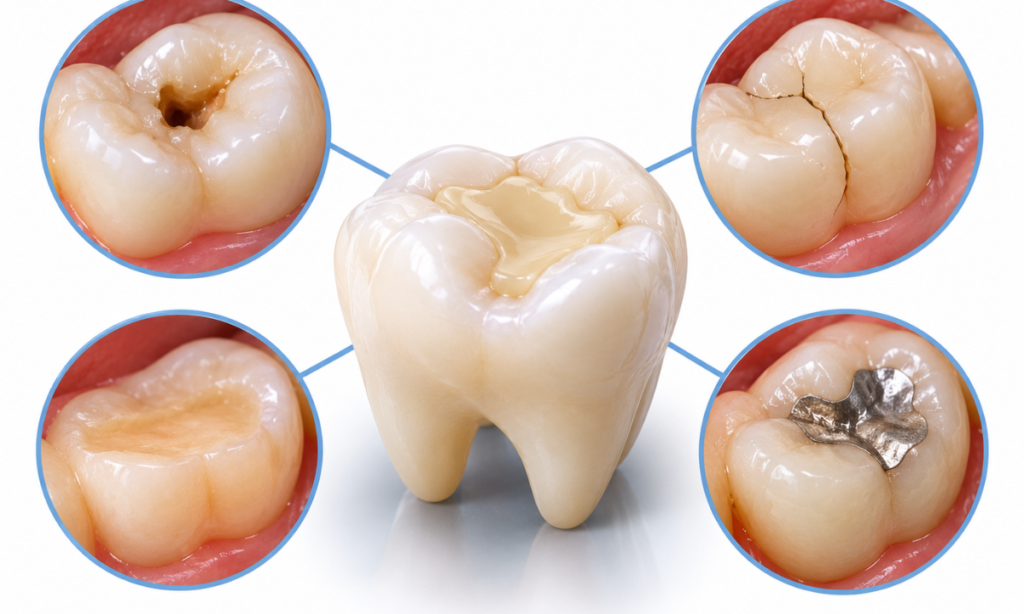
A dentist may recommend an inlay when a tooth needs more extensive repair than a conventional filling can provide.
Common situations include:
- Moderate tooth damage: When decay or damage affects a substantial part of the chewing surface.
- Replacement of an old restoration: When an existing filling needs replacement and an inlay is suitable.
- Cracked or weakened tooth structure: When the damage can be restored without requiring a full crown, depending on the location and extent of the crack.
- Large cavities: When a direct filling may not be the most suitable option for restoring the affected area.
- Restoration of back teeth: When the chewing surface needs a custom-made restoration that can withstand normal biting forces.
Not every damaged tooth requires an inlay. Depending on the condition, a dentist may recommend a filling, onlay, dental crown, or even dental implants instead.
Factors That Affect Dental Inlay Price
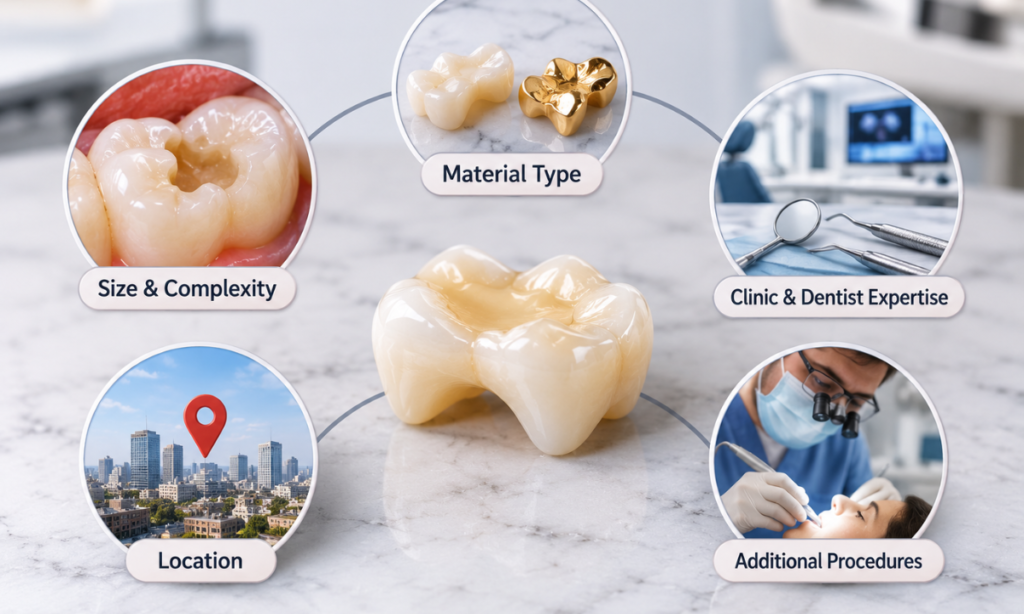
Several factors can influence the total cost of treatment.
1. Restoration Material
Ceramic inlays are designed to match the appearance of natural teeth. The material selected can affect the price, appearance, and clinical suitability of the restoration.
2. Extent of Tooth Damage
A small area of damage may require a simpler restoration than a large cavity involving several surfaces. If the tooth has extensive structural damage, an onlay or crown may be more appropriate.
3. Additional Dental Treatment
If decay is deep or the tooth has other problems, additional procedures, such as professional teeth cleaning, may be necessary before the final restoration is fitted. These procedures can increase the overall treatment cost.
4. Digital Scanning and Fabrication
Some clinics use digital scanning and computer-aided design and manufacturing (CAD/CAM) to produce restorations. Other clinics may use conventional impressions and a dental laboratory.
The workflow can affect the number of appointments and the process used to make the restoration.
5. Dentist’s Clinical Assessment
The final recommendation depends on the tooth’s condition, bite, remaining structure, and the suitability of the proposed material.
Dental Inlay vs Filling: What Is the Difference?
Both fillings and inlays restore damaged teeth, but they differ in how they are made and when they may be used.
| Feature | Dental filling | Dental inlay |
| Placement | Usually placed and shaped directly in the tooth | Fabricated separately and then fitted |
| Suitable cases | Often used for small to moderate cavities | May be considered for larger areas of damage |
| Materials | Commonly composite resin or other filling materials | May be made from ceramic or other suitable materials |
| Number of visits | Often completed in one visit | May require one or more visits, depending on the workflow |
| Custom fabrication | Usually shaped directly by the dentist | Custom-made to fit the prepared area |
| Cost | Generally less expensive | Generally more expensive than a conventional filling |
A filling may be sufficient when the damage is limited. An inlay may be considered when a larger restoration is needed and the remaining tooth structure is suitable.
Neither option is automatically better for every patient.
Dental Inlay vs Onlay: Which Is More Suitable?
An inlay and an onlay are both indirect dental restorations, but they cover different parts of a tooth.
An inlay fits within the prepared area between the tooth’s cusps and does not cover the cusp tips. An onlay extends over one or more cusps, providing coverage for a larger area of the tooth.
| Feature | Inlay | Onlay |
| Coverage | Fits within the prepared area between the cusps | Covers one or more cusps |
| Extent of repair | Often suitable for damage that does not require cusp coverage | May be suitable when one or more cusps need protection |
| Tooth structure | Preserves the cusps when they remain suitable for restoration | Covers cusps that need additional support |
| Treatment choice | Depends on the location and extent of damage | Depends on the location and extent of damage |
| Cost at DDC Smiles | ₹10,000–₹12,000 | ₹12,000 |
The dentist will decide which restoration is suitable after examining the tooth. An onlay may be preferable when the chewing cusps are weakened, but the best option depends on the individual case.
Dental Inlay vs Crown
A dental crown covers a larger portion of a tooth, while an inlay restores a more limited area within the chewing surface.
A dentist may recommend an inlay when the remaining tooth structure is strong enough to support it. A crown may be considered when the tooth is extensively damaged or weakened and requires more comprehensive coverage.
The decision depends on factors such as:
- The amount of healthy tooth structure remaining.
- The size and location of the cavity or fracture.
- The condition of the tooth’s cusps.
- The forces placed on the tooth during chewing.
- Whether the tooth has undergone root canal treatment.
The aim is to select a restoration that repairs the damage while preserving as much healthy tooth structure as reasonably possible.
How Is a Dental Inlay Procedure Performed?
The treatment process varies according to the condition of the tooth and the clinic’s fabrication method. A typical procedure may involve the following steps.
Step 1: Dental Examination
The dentist examines the tooth and may take dental X-rays when clinically necessary to assess the extent of decay or other damage.
Step 2: Removal of Damaged Tooth Structure
The affected area is cleaned, and decay is removed where necessary. The dentist prepares the tooth to receive the restoration.
Step 3: Digital Scan or Dental Impression
A digital scan or conventional impression records the prepared tooth so that the restoration can be made to fit accurately.
Step 4: Inlay Fabrication
The restoration is fabricated using the selected material. Depending on the clinic’s equipment and workflow, it may be produced through a digital CAD/CAM process or by a dental laboratory.
Step 5: Fitting and Bonding
The dentist checks the inlay’s fit, shape, and bite before bonding or cementing it into place.
Step 6: Final Bite Check
The dentist checks how the restored tooth meets the opposing teeth and makes adjustments if required.
Some suitable cases can be completed in one visit when the clinic has an appropriate same-day digital workflow. Other cases require multiple appointments.
How Long Does a Dental Inlay Last?
With good care, a dental inlay may provide many years of service. Its lifespan depends on the restoration material, the amount of remaining tooth structure, bite forces, oral hygiene, and regular dental reviews.
You can help maintain your restoration by:
- Brushing twice daily with fluoride toothpaste.
- Cleaning between your teeth every day.
- Attending regular dental check-ups.
- Avoiding biting hard objects such as ice or hard non-food items.
- Seeking advice if you grind or clench your teeth.
An inlay does not make the tooth immune to future decay or damage. The surrounding tooth structure and the margins of the restoration still need proper care.
Possible Risks and Aftercare
As with other dental restorations, an inlay may become loose, chip, or require replacement over time. Temporary sensitivity to hot, cold, or pressure can occur after tooth preparation or fitting, particularly when the original damage was deep.
Contact your dentist if you experience severe pain, worsening discomfort, a change in your bite, or sensitivity that persists rather than improving.
To protect your restoration:
- Maintain good oral hygiene around the restored tooth.
- Avoid biting hard objects that could damage the restoration.
- Follow your dentist’s instructions after treatment.
- Attend recommended follow-up appointments.
- Tell your dentist if you clench or grind your teeth.
If grinding places excessive force on the restoration, your dentist may recommend a night guard. The need for one depends on your individual bite and clinical assessment.
Who Is a Suitable Candidate for a Dental Inlay?
A dental inlay may be appropriate for someone who has a damaged or decayed tooth that needs more extensive repair than a routine filling can provide, provided enough healthy tooth structure remains.
The dentist will consider several factors before recommending an inlay:
- The size and location of the damaged area.
- The condition of the tooth’s cusps.
- The amount of healthy tooth structure remaining.
- Whether the tooth has deep decay or pulp involvement.
- The patient’s bite and any history of teeth grinding.
- Whether another restoration would provide more suitable coverage.
If decay has reached the tooth’s pulp, root canal treatment may be required before the tooth can be restored. If the tooth is extensively weakened, an onlay or crown may be more appropriate.
Dental Inlay Treatment at DDC Smiles
Choosing a restoration requires an assessment of the damaged tooth, the remaining tooth structure, and the forces acting on it.
DDC Smiles publishes pricing for ceramic inlays and onlays. Patients can review the clinic’s price list and dental services before enquiring about treatment.
Dental Inlay Treatment in Koramangala
If you are looking for restorative dental treatment in Koramangala, the first step is to have the affected tooth examined. The dentist can determine whether a filling, inlay, onlay, or crown is appropriate and explain the expected cost.
Visit the DDC Smiles website to find out more about the clinic and its services.
Dental Inlay Treatment in HSR Layout
Patients in and around HSR Layout who need a damaged tooth restored should seek an examination before deciding on a particular treatment. The appropriate restoration depends on the extent of damage, the tooth’s condition, and the available treatment options.
For appointment enquiries and current pricing, visit the DDC Smiles contact page.
Frequently Asked Questions
1. What is the dental inlay cost in Bangalore?
The cost depends on the material, the extent of tooth damage, and any additional treatment required. DDC Smiles’ published price list lists ceramic inlays at ₹10,000–₹12,000 per tooth. Confirm the current fee and inclusions with the clinic before treatment.
2. What is the ceramic inlay price at DDC Smiles?
The published price for a ceramic dental inlay at DDC Smiles is ₹10,000–₹12,000 per tooth. The final cost may vary if additional procedures are needed.
3. Is a dental inlay better than a filling?
Not necessarily. A filling may be suitable for a smaller cavity, while an inlay may be considered for a larger area of damage. The dentist will recommend an option based on the tooth’s condition and the amount of healthy structure remaining.
4. What is the difference between an inlay and an onlay?
An inlay fits within the prepared area between the tooth’s cusps. An onlay extends over one or more cusps and may be recommended when those areas need additional coverage or support.
5. Can a dental inlay be completed in one visit?
Sometimes. A clinic with suitable digital scanning, design, and milling equipment may be able to fabricate and fit an inlay during one visit when the case is appropriate. Other cases require multiple appointments, particularly when the restoration is made by a dental laboratory.
6. How long does a dental inlay last?
A dental inlay may last for many years with appropriate care. Its lifespan depends on the material, oral hygiene, bite forces, the condition of the tooth, and regular dental reviews.
7. Is a ceramic dental inlay painful?
The procedure is generally performed with local anaesthesia when needed to keep the patient comfortable. Some temporary sensitivity may occur after treatment. Persistent or worsening pain should be assessed by a dentist.
8. Is a dental inlay suitable for a large cavity?
It may be suitable if the tooth has enough healthy structure to support the restoration. If the damage extends over one or more cusps, an onlay may be more appropriate. Extensive damage may require a crown.
9. Can I get an inlay after root canal treatment?
In some cases, yes. The appropriate restoration depends on how much tooth structure remains and how much protection the tooth needs. A tooth that has undergone root canal treatment may require an onlay or crown rather than an inlay.
10. Does the dental inlay price include all treatment charges?
Not necessarily. Confirm whether the quoted fee includes consultation, scanning or impressions, temporary restoration, bonding, bite adjustment, and follow-up visits. Additional procedures, such as root canal treatment or core build-up, may cost extra.
Conclusion
The dental inlay cost in Bangalore depends on the restoration material, the condition of the tooth, and the procedures required. DDC Smiles’ published price for a ceramic inlay is ₹10,000–₹12,000 per tooth, while its ceramic onlay is listed at ₹12,000.
A filling, inlay, onlay, or crown may be appropriate depending on the extent of damage and the amount of healthy tooth structure remaining. A dental examination is the best way to determine the suitable treatment and confirm the total cost.
To discuss your options, visit DDC Smiles and enquire about current pricing and appointment availability.
Reference:
1.https://highfieldavedental.co.uk/dental-inlays-and-onlays-explained/
